Featured Tale
Development of an Open Educational Resource for Fundamentals of Communication
Sheri A. Trivane, MA
From the Communication Arts Department, School of Arts and Communication, Community College of Baltimore County, Baltimore, Maryland.
Sheri A. Trivane, MA
strivane@ccbcmd.edu
INTRODUCTION
The use of open educational resources (OERs) across higher education is on the rise. In a survey of higher education faculty across the U.S. 33% of respondents reported using an OER for the 2024-2025 school year. This is up from 15% just 5 years earlier (Bay View Analytics, n.d.). By providing students with a zero textbook cost resource, like an OER, we can lower the barrier of textbook expenses without significantly affecting student outcomes (Brockman et al., 2025).
At the Community College of Baltimore County (CCBC), providing an accessible, affordable and high-quality education is a core part of our mission (Community College of Baltimore County, n.d.). For years, department administrators and faculty have been encouraged to provide students with more affordable resources. With these factors in mind, the Communication Arts Department decided to develop a new OER for Fundamentals of Communication (CMNS 101), one of the college’s highest enrolled credit courses. Our goals were to reduce financial barriers for students while also modernizing course materials to better reflect how today’s students engage with content. To do this we combined traditional written materials with multimedia learning tools designed to create a more accessible and engaging learning experience across all course modalities that we could offer at zero cost to our students.
FUNDING
Our first step was obtaining grant funding through a program administered by CCBC’s Textbook Affordability Committee. Since its launch in 2019, this faculty-driven program has supported 76 faculty projects spanning 75 courses across all of CCBC’s schools. Their goal is “to position the college as an active contributor to the broader open education movement while directly addressing the financial barriers that community college students disproportionately face” (S. Pyle, personal communication, June 29, 2026).
OERs fall under the zero textbook cost initiative at CCBC which also includes library licensed materials and other freely available materials. This project has been implemented widely at CCBC with 42% of all credit course sections using these materials as of the 2025-2026 academic year. That breaks down to 2,684 sections of 443 non-duplicated courses with a duplicated headcount of 37,919 students. At this scale, CCBC saved its students an estimated $2,848,425. If all the impacted courses since summer 2020 are considered, CCBC students have saved an estimated $11,078,025 (S. Pyle, personal communication, June 29, 2026).
PLANNING
Rather than adapting an existing OER from another publisher or institution, CCBC’s CMNS 101 OER Committee decided to utilize educational materials originally developed by faculty member Steven Zwier for a contextualized CMNS 101 course. Using his resource as a jumping off point, we collaborated with faculty, instructional technology, and library support services. We met with an open resource librarian to review grant expectations, discuss accessibility standards, and establish a timeline for implementation and assessment. We then analyzed the CMNS 101 common course outline to ensure that every course objective and learning outcome would be represented within the new resource. With this plan in mind, we began the painstaking process of writing, editing, and organizing the text so that it would align with the common course outline and best serve the needs of students taking CMNS 101. Finally, we mapped out what we wanted to include in our OER and began development.
DEVELOPMENT AND IMPLEMENTATION
As the project moved into development, we worked closely with instructional technology staff using H5P software to build interactive online materials (based on our text) that could be integrated into CCBC’s learning management system Brightspace. Rather than recreating a traditional textbook in digital form, we intentionally designed the OER as a multimedia learning experience that could meet students with different learning preferences and study habits. In addition to a downloadable PDF for each chapter, we decided each chapter would include an overview, a podcast (with transcript), vocabulary review materials, flashcards, and summaries. For the podcasts, the instructional technology staff utilized the H5P program which uses AI scripting and voice actors. This allowed us to eliminate the timely process of recording them ourselves.
The Pilot
Throughout the process, collaboration and feedback were a priority. Before the Fall 2025 pilot launch, the OER materials were shared with CMNS 101 faculty members for review and input. We made some last minute adjustments, and then we were ready for a test run. Six faculty members volunteered to use the OER for 1 of their Fall 2025 classes. At the end of the semester, both faculty and students completed surveys evaluating the effectiveness of the resource. Student responses were overwhelmingly positive. Of the 33 students who responded, 84% found the textbook to be “good” or “excellent” overall. Faculty feedback also helped shape revisions before the full implementation. This led to the addition of instructional resources including chapter slides and quizzes from the online institutional course. Recent faculty feedback requested more academic resources so the final version will include “Works Cited” and “Additional Resources” sections to further strengthen the academic credibility and usability of the resource.
Full Implementation
The OER was fully implemented across all CMNS 101 sections and modalities in Spring 2026, and the transition was smooth across the department. Faculty reported that the new materials integrated well into their courses, and overall feedback indicated that the resources were working effectively across different teaching modalities.
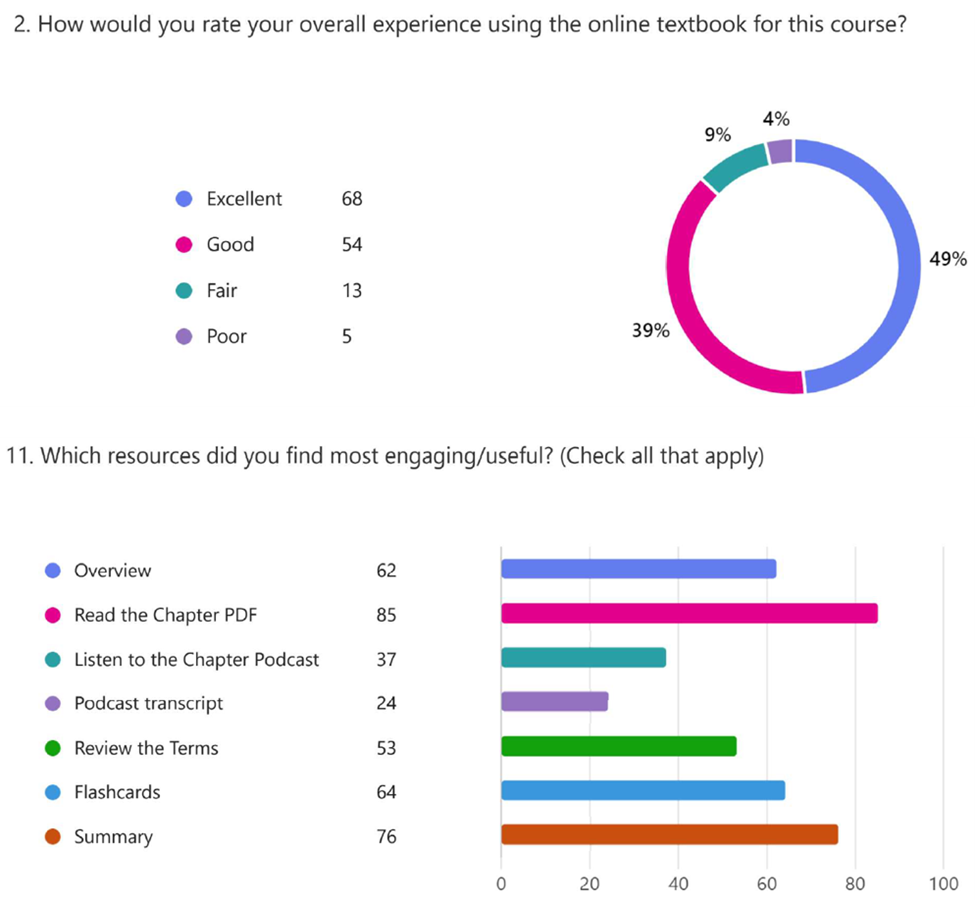
Students also completed a follow-up survey evaluating the effectiveness of the resource during the Spring 2026 semester. Their responses were again overwhelmingly positive. Of the more than 1,800 students surveyed, 142 responded, about 13%. Figure 1 shows that 88% of student respondents found the textbook to be “good” or “excellent” overall. The students also found it easy to use, with 81% saying it was “easy” or “very easy” to navigate and understand. When asked how helpful the textbook was in supporting class activities and assignments, 81% said it was “helpful” or “very helpful” (not shown). Interestingly, the students found a variety of resources beyond the text useful, such as the summaries and flashcards, which supports our goal of providing resources for multiple learning preferences (Figure 1).
THE OER’S IMPACT
The main impact of the OER is that it saves students money. CMNS 101 is the 2nd-highest enrolled credit course at CCBC, and based on enrollment data our OER project saves students around $100,000 per semester. For Spring 2026, we helped over 1,900 registered students keep more money in their pockets. Beyond affordability, we also believe that providing information in multiple formats better aligns with modern student learning preferences. Students can now choose to read chapter materials, listen to podcasts, review transcripts, or engage with interactive study tools depending on their individual learning styles and schedules.
The OER Grant also emphasized collaboration and knowledge sharing beyond the college itself. As part of the award requirements the completed OER will be shared publicly through Maryland Open Source Textbook Commons (https://most.oercommons.org/ with a link to the CCBC hub, making the resource available for adoption by other institutions.
Finally, the CMNS 101 OER represents more than simply a replacement for a textbook. It demonstrates how innovation can address affordability while also rethinking how course content is delivered to students. Looking ahead, we will continue to encourage feedback which will help shape future revisions and improvements. Most importantly, The CMNS 101 OER serves as an example of how thoughtful collaboration and institutional support can create meaningful impacts for students while contributing to broader conversations about the future of teaching and learning in higher education.
ACKNOWLEDGEMENTS
I thank all of the many people who were instrumental in creating the CMNS 101 OER at CCBC. Most significantly, Associate Professor Steven Zwier was the original author of the source material and my partner in the yearlong crafting and editing process. Additional thanks to the CMNS 101 OER Committee, Instructional Technology staff Natalie Johnson and Shawn Crosby, OER Librarian Shaune Pyle, and Communication Arts Chair Rebecca Minor.
References
- Community College of Baltimore County. (n.d.). Mission and values. https://www.ccbcmd.edu/About/Mission-and-Values/index.html
- Bay View Analytics. (n.d.). National survey shows higher education faculty embracing digital and open educational resources (OER). https://www.bayviewanalytics.com/press_release/higher_education_faculty_embracing_digital.html
- Brockman, S. L., Ledermann, M., & Weissman, A. (2025). Evaluating the effects and cost-effectiveness of adopting open educational resources in Michigan community college courses [Conference paper]. Society for Research on Educational Effectiveness 2025 Conference. https://eric.ed.gov/?id=ED677706