Research Article
Belonging Begins Here: Exploring Belongingness, Adversity, and Rapport in Introductory Psychology
From the Psychology Department, School of Wellness, Behavioral, and Social Sciences, Community College of Baltimore County, Baltimore, Maryland.
Chelsea L. Robertson, PhD
crobertson@ccbcmd.edu
ABSTRACT
Student–instructor rapport has been consistently linked to positive student outcomes including increased class attendance, motivation to learn, and deeper cognitive engagement. However, less is known about how students’ prior exposure to trauma may shape their rapport with instructors and sense of belongingness within the classroom. The present study examined relationships among adverse childhood experiences (ACEs), course-level belongingness, student–instructor rapport, and perceived cognitive learning outcomes within introductory psychology courses at the Community College of Baltimore County. Results indicated that students who reported higher levels of rapport with their instructor also reported significantly greater course belongingness and higher levels of perceived cognitive learning. Additionally, female students reported significantly stronger rapport with their instructor than male students. Among ACEs, students who reported experiencing verbal abuse demonstrated significantly higher levels of both belongingness and perceived cognitive learning compared to students who did not report verbal abuse; no other ACEs were significantly associated with the outcome variables. Only the relationship between ACEs (verbal abuse) and perceived cognitive learning survived a Bonferroni post-hoc correction. These findings highlight the central role of instructor–student relationships in fostering belonging and learning in introductory courses and suggest that certain trauma histories may interact with classroom dynamics in complex ways. Future research should further investigate the mechanisms through which exposure to verbal abuse influences student–faculty rapport and course belongingness.
INTRODUCTION
A student’s sense of belonging within their institution is a critical factor shaping multiple aspects of the postsecondary experience, including enrollment decisions, persistence, and the likelihood of degree completion (Tinto, 2017; Won et al., 2021). Sense of belonging broadly reflects students’ perceptions of being accepted, valued, and supported within an educational environment. While belongingness is important for all students, it is particularly salient for individuals from historically marginalized backgrounds, including students marginalized on the basis of race or ethnicity, sexual orientation, gender identity, or socioeconomic status (Strayhorn, 2018). These students often encounter structural and interpersonal barriers that can undermine their connection to postsecondary institutions, amplifying the consequences of exclusion or disengagement.
The role of belongingness may be especially consequential within the community college context. Community colleges serve a disproportionately high number of students from historically marginalized backgrounds and students who are first-generation, low-income, or balancing competing work and family responsibilities. Despite their central role in promoting access to higher education, students attending 2-year institutions consistently report lower levels of belonging than their peers at 4-year institutions (Gopalan & Brady, 2020). Given the strong association between belongingness and student success outcomes, examining how belongingness operates within community colleges is particularly important for advancing equity and improving student persistence and completion at these institutions.
Belongingness can be conceptualized and assessed at multiple levels, including the institutional, programmatic, and classroom levels, and from diverse student perspectives. However, measuring and promoting this construct has become increasingly complex as postsecondary environments continue to evolve (Slaten et al., 2018). Existing research on belongingness in community colleges has largely focused on specific student identity groups (e.g., Maramba & Museus, 2012; Vaccaro et al., 2015), with comparatively less attention given to other meaningful grouping factors, such as academic major, course enrollment patterns, or classroom-level dynamics. This gap limits understanding of how everyday instructional contexts contribute to students’ sense of belonging, particularly in settings where students may have limited engagement with the broader institution.
Within the classroom, interactions with instructors play a critical role in shaping students’ sense of belonging. Prior research demonstrates that positive instructional experiences, such as feeling valued by faculty, developing supportive relationships, and perceiving instructors as approachable, are associated with stronger feelings of belongingness (Cooner, 2019; Hoffman et al., 2002). These effects may be further amplified when instructors employ effective, student-centered teaching practices that promote engagement and inclusion. As such, the classroom represents a key site for fostering belonging, particularly in community colleges where students may have fewer opportunities for campus-based social integration.
One instructional practice that may contribute meaningfully to students’ sense of belonging is the development of instructor–student rapport. Rapport-building involves behaviors such as using transparent and fair grading practices, demonstrating respect for students, and treating all students with dignity (Wilson et al., 2010). While building and maintaining rapport is important in all educational settings, it may be especially critical, and more challenging, for instructors teaching students with significant trauma histories. Research indicates that most students arrive on college and university campuses having experienced at least one traumatic event, and many will experience additional trauma prior to graduation (Cusack et al., 2018; Frazier et al., 2009; Read et al., 2011). One particularly salient form of trauma, adverse childhood experiences (ACEs), characterizes early adversity as exposure to one or more types of abuse (physical, sexual, or emotional), neglect (emotional or physical), or household dysfunction (parental substance use, mental illness, or incarceration, or the witnessing of violence towards a caregiver) prior to the age of 18 (Felitti et al., 1998). For students with significant numbers of ACEs, classroom interactions that signal safety, respect, and care may be particularly influential in shaping their sense of belonging and engagement.
Within the present study, attention is directed toward the classroom-level dynamics that may foster students’ sense of belongingness within a community college context, with a specific focus on introductory psychology courses. Introductory psychology is often a high-enrollment, foundational course that serves students across a wide range of academic majors and backgrounds, making it a particularly salient context for examining instructor–student interactions and perceptions of learning (Gurung et al., 2016).
In the present study, it was hypothesized that students’ sense of belongingness within an introductory psychology course (PSYC 101) at the Community College of Baltimore County would be significantly and positively correlated with their rapport with their instructor, their perceived learning in the course, and their reported ACE scores. It was also hypothesized that female students would report greater rapport with their instructor than male students, as previous research has found that an instructor’s gender may influence the level of rapport experienced by their students (e.g., Joye & Wilson, 2015). By examining these relationships, this study seeks to contribute to a more nuanced understanding of how instructional relationships within community college classrooms may support both affective and academic dimensions of student success.
METHODS
Participants included 37 students enrolled in PSYC 101 courses taught by the author at the Community College of Baltimore County. Students were recruited across 3 academic terms: Fall 2024, Spring 2025, and Fall 2025. Upon providing informed consent, participants were invited via email to complete an anonymous online survey. Participation was voluntary, and no identifying information was collected.
The sample was predominantly female (n = 23; 62.16%). Fifteen participants (40.54%) identified as first-generation college students. Participants ranged widely in age, with a mean age of 26.48 years (Mdn = 20.00 years, SD = 11.58), reflecting the diverse age profile typical of community college populations.
Procedure
Following approval from the appropriate institutional review process, students enrolled in PSYC 101 were informed about the study and provided with a consent form. Students who consented were subsequently emailed a link to the anonymous survey. Data collection occurred during weeks 12 through 15 of each 15-week semester. This timing was selected to ensure that students had sufficient exposure to their instructor and course structure to meaningfully evaluate instructor–student rapport, course belongingness, and perceived cognitive learning outcomes.
The survey was administered online and could be completed at the time and location of the student’s choosing. All measures were presented in a fixed order, beginning with demographic items, followed by self-report scales assessing instructor rapport, perceived cognitive learning, ACEs, and course belongingness. Completion time for the survey was approximately 20 minutes.
Measures
Demographics
Participants completed 3 demographic items assessing gender identity, first-generation college student status, and age. First-generation status was defined as being the first in one’s family to attend college.
Student–Instructor Rapport
Student–instructor rapport was measured using the Professor–Student Rapport Scale (34 items; Wilson & Ryan, 2013). This scale assesses students’ perceptions of their relationship with their instructor (i.e., the author of the present study), including approachability, respect, fairness, and interpersonal connection. Most items measure general perceptions and characteristics of instructors (e.g., “My professor encourages me to succeed”), some items measure specific instructor behaviors (e.g., “My professor maintains eye contact with me”), and several items measure the perceived quality of the interaction between the student and professor (e.g., “My professor and I get along”). Items are rated on a 5-point Likert-type scale (1 indicating “strongly disagree”; 5 indicating “strongly agree”), with higher scores indicating stronger perceived rapport. The scale has demonstrated strong reliability and validity in prior research with college student populations.
Perceived Cognitive Learning
Perceived cognitive learning was assessed using a 10-item cognitive learning measure developed by Frisby and Martin (2010). This measure evaluates students’ self-reported understanding of course material (e.g., “I can clearly recall information from this class”), perceived intellectual growth (e.g., “I have learned a great deal in this class”), and mastery of learning objectives (e.g., “I have learned information that I can apply”). Items are rated using a 5-point Likert-type scale (1 indicating “strongly disagree”; 5 indicating “strongly agree”), with higher scores reflecting greater perceived learning.
Adverse Childhood Experiences
Exposure to trauma prior to age 18 was assessed using the Philadelphia Adverse Childhood Experiences (ACEs) Questionnaire (21 items; Cronholm et al., 2015). This measure captures a range of adverse experiences, including abuse, neglect, and household dysfunction, and each subscale has a threshold for adversity (e.g., answering “Yes” for the item “Have you ever lived in foster care?” indicates adversity, while a score of “some of the time” or “none of the time” indicates adversity for the item “Did you feel safe in your neighborhood?”). Participants indicated whether they had experienced each event during childhood (e.g., “Did you feel safe in your neighborhood?”). Consistent with prior research, ACEs were examined both as a cumulative score and by individual experience type.
Course Belongingness
Students’ sense of belonging within their PSYC 101 course was measured using the Brief Course Belongingness Scale (11 items; Toland et al., 2023). This scale assesses students’ feelings of acceptance, inclusion, and connection within the course environment (e.g., “I feel like other students in this course encourage me to do well.”). Responses are provided on a 5-point Likert-type scale (1 indicating “strongly disagree”; 5 indicating “strongly agree”), with higher scores indicating a stronger sense of course belongingness.
RESULTS
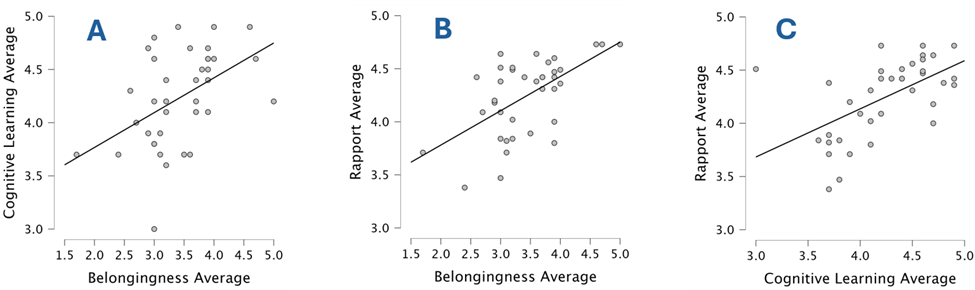
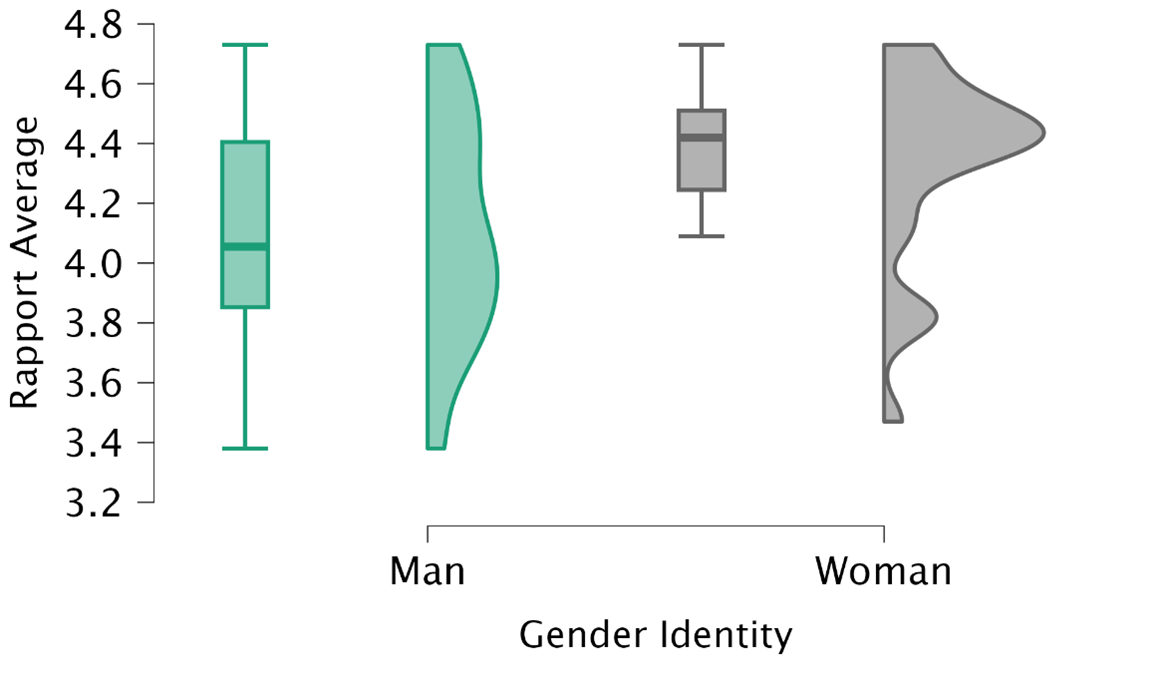
A series of Pearson’s correlations were used to examine the relationships among students’ ACEs, feelings of belongingness in the course, rapport with their instructor, and perceived cognitive learning within the course (Table 1). Students’ sense of belongingness was positively and significantly correlated with their perceived cognitive learning (r = 0.474, p = 0.003; Figure 1) and their rapport with their instructor (r = 0.583, p < 0.001; Figure 2). Students’ rapport with their instructor was also positively and significantly correlated with their perceived cognitive learning (r = 0.564, p < 0.001; Figure 3). Students’ ACE scores, however, were not significantly correlated with their course belongingness, perceived cognitive learning, or rapport with their instructor. Analyses also revealed that students who identified as female reported greater rapport with their instructor than male students, t(35) = 1.863, p = 0.035 (Figure 2).
| Table 1. Pearson’s Correlations between Study Variables. | |||||
|---|---|---|---|---|---|
| Belongingness Average | Cognitive Learning Average | Rapport Average | ACEs Total | ||
| Belongingness Average | Pearson's r | — | |||
| p-value | — | ||||
| Cognitive Learning Average | Pearson's r | 0.474 | — | ||
| p-value | 0.003 | — | |||
| Rapport Average | Pearson's r | 0.583 | 0.564 | — | |
| p-value | < 0.001 | < 0.001 | — | ||
| ACEs Total | Pearson's r | 0.192 | 0.092 | 0.132 | — |
| p-value | 0.254 | 0.588 | 0.435 | — | |
Exploratory analyses revealed that experiencing emotional abuse was positively and significantly correlated with course belongingness (r = 0.446, p = 0.006) and perceived cognitive learning (r = 0.474, p = 0.003). Upon using a Bonferroni correction for multiple comparisons, the latter relationship (a positive correlation between experiencing emotional abuse and perceived cognitive learning) remained.
DISCUSSION AND CONCLUSION
The purpose of the present study was to examine the relationships among ACEs, student–instructor rapport, course-level belongingness, and perceived cognitive learning within the author’s PSYC 101 courses at the Community College of Baltimore County. Consistent with prior research, these findings underscore the central role of instructor–student relationships in shaping students’ affective and cognitive experiences in the classroom. Specifically, higher levels of student–instructor rapport were associated with stronger feelings of course belongingness and greater perceived cognitive learning, supporting the hypothesis that rapport functions as a key mechanism through which students experience connection and engagement in introductory, high-enrollment courses.
Student–Instructor Rapport, Belongingness, and Learning
The current results align with previous studies demonstrating that positive relationships with instructors are linked to improved student outcomes, including motivation, engagement, and learning (Grantiz et al., 2008; Mattanah et al., 2024; Wilson & Ryan, 2013). The observed associations between rapport and both belongingness and perceived learning reinforce theoretical frameworks emphasizing the importance of relational pedagogy and social integration in postsecondary education (Tinto, 2017; Strayhorn, 2018). In community college contexts, where students may have fewer opportunities for institutional attachment beyond the classroom, instructor behaviors that foster approachability, respect, and fairness may be particularly influential in promoting a sense of belonging.
The finding that rapport was positively related to perceived cognitive learning further highlights the interdependence of affective and academic processes. When students feel valued and supported by their instructors, they may be more willing to engage deeply with course content, seek clarification, and persist through academic challenges. These findings support calls for faculty development initiatives that emphasize relationship-building and inclusive teaching practices, particularly in foundational courses such as introductory psychology.
Gender Differences in Reported Rapport
Female students reported significantly higher levels of rapport with their instructor than male students. This finding is consistent with some prior research suggesting gender differences in help-seeking behaviors, communication styles, and relational engagement within academic settings. Female students may be more likely to perceive or seek interpersonal connection with instructors, whereas male students may engage less frequently in relationship-building behaviors or may interpret rapport differently. However, given the modest sample size, this finding should be interpreted with caution and warrants further investigation to determine whether these differences persist across disciplines, instructional modalities, or instructor gender.
Adverse Childhood Experiences and Classroom Outcomes
One of the more unexpected findings of the study was that students who reported experiencing verbal abuse demonstrated significantly higher levels of course belongingness and perceived cognitive learning compared to students who did not report verbal abuse. No other ACEs were significantly associated with the outcome variables. This result diverges from much of the literature linking childhood trauma to negative academic and psychosocial outcomes, but it is not entirely inconsistent with emerging research suggesting that some students with trauma histories may develop adaptive coping strategies or heightened sensitivity to supportive relational environments.
It is possible that students with histories of verbal abuse may be particularly attuned to respectful, affirming instructor behaviors and thus experience stronger perceptions of belonging and learning when classroom interactions contrast with earlier negative experiences (e.g., Dube et al., 2023). Alternatively, these students may place greater value on positive authority relationships, which could amplify the impact of instructor rapport on their classroom experiences. These interpretations remain speculative, and the cross-sectional design of the study precludes causal conclusions.
Implications for Trauma-Informed and Community College Pedagogy
Findings from this study have several implications for trauma-informed teaching and community college pedagogy. The strong associations among rapport, belongingness, and learning suggest that instructor behaviors that promote psychological safety, consistency, and respect may be particularly impactful for students with diverse life experiences. Faculty training that emphasizes transparent communication, equitable grading practices, and relational consistency may support both academic success and emotional wellbeing, especially in introductory courses that serve as gateways to further coursework.
The observed relationship between verbal abuse and positive classroom outcomes further underscores the need for nuanced, trauma-informed approaches that recognize variability in how students respond to and interpret supportive educational environments. Rather than assuming uniform vulnerability or deficit, instructors and institutions may benefit from approaches that emphasize strength-based engagement and relational trust.
Limitations and Future Directions
Several limitations should be considered when interpreting these findings. First, the small sample size limits statistical power and generalizability. Second, reliance on self-report measures may introduce response bias, particularly in assessments of perceived learning. Third, the cross-sectional design prevents conclusions about directionality or causality among variables. Finally, the sample was drawn from a single institution and course, which may limit applicability to other contexts.
Future research should replicate these findings with larger, more diverse samples and employ longitudinal or mixed-methods designs to better understand how rapport and belongingness develop over time. In particular, further exploration of the role of verbal abuse and other specific ACEs in shaping student–faculty relationships is warranted. Qualitative approaches may be especially valuable for capturing students’ lived experiences and interpretations of classroom interactions.
Conclusion
Overall, the present study contributes to the growing literature on belongingness, rapport, and trauma in postsecondary education by highlighting the pivotal role of instructor–student relationships within community college classrooms. Findings suggest that fostering strong rapport may enhance both students’ sense of belonging and their perceived learning, and that prior trauma experiences may interact with classroom dynamics in complex and unexpected ways. By centering relational practices in instructional design and faculty development, community colleges may be better positioned to support student success across diverse backgrounds and life experiences.
ACKNOWLEDGEMENTS
A special thank you to the Society for the Teaching of Psychology’s Teaching and Learning Workshop and to Dr. Jared Keeley of the Virginia Commonwealth University for making this project possible!
REFERENCES
- Cooner, E. A. (2019). Creating a culture that instills students’ sense of belonging yields positive outcomes (Publication No. 13899548) [Doctoral dissertation, University of Pennsylvania]. ProQuest Dissertations & Theses Global. https://www.proquest.com/docview/2285296117
- Cusack, S. E., Hicks, T. A., Bourdon, J., Sheerin, C. M., Overstreet, C. M., Kendler, K. S., Dick, D. M., & Amstadter, A. B. (2019). Prevalence and predictors of PTSD among a college sample. Journal of American College Health, 67(2), 123–131. https://doi.org/10.1080/07448481.2018.1462824
- Dube, S. R., Li, E. T., Fiorini, G., Lin, C., Singh, N., Khamisa, K., McGowan, J., & Fonagy, P. (2023). Childhood verbal abuse as a child maltreatment subtype: A systematic review of the current evidence. Child Abuse & Neglect, 144, 106394. https://doi.org/10.1016/j.chiabu.2023.106394
- Felitti, V. J., Anda, R. F., Nordenberg, D., Williamson, D. F., Spitz, A. M., Edwards, V., & Koss, M. P. (1998). Relationship of childhood abuse and household dysfunction to many of the leading causes of death in adults: The adverse childhood experiences (ACE) study. American Journal of Preventive Medicine, 14(4), 245–258. https://doi.org/10.1016/S0749-3797(98)00017-8
- Frazier, P., Anders, S., Perera, S., Tomich, P., Tennen, H., Park, C., & Tashiro, T. (2009). Traumatic events among undergraduate students: Prevalence and associated symptoms. Journal of Counseling Psychology, 56(3), 450–456. https://doi.org/10.1037/a0016412
- Gopalan, M., & Brady, S. T. (2020). College students’ sense of belonging: A national perspective. Educational Researcher, 49(2), 134–137. https://doi.org/10.3102/0013189X19897622
- Gurung, R. A. R., Hackathorn, J., Enns, C., Frantz, S., Cacioppo, J. T., Loop, T., & Freeman, J. E. (2016). Strengthening introductory psychology: A new model for teaching the introductory course. American Psychologist, 71(2), 112–124. https://doi.org/10.1037/a0040012
- Hoffman, M., Richmond, J., Morrow, J., & Salomone, K. (2002). Investigating “sense of belonging” in first-year college students. Journal of College Student Retention, 4(3), 227–256. https://doi.org/10.2190/DRYC-CXQ9-JQ8V-HT4V
- Joye, S., & Wilson, J. H. (2015). Professor age and gender affect student perceptions and grades. Journal of the Scholarship of Teaching and Learning, 15(4), 126–138. https://doi.org/10.14434/josotl.v15i4.13466
- Maramba, D. C., & Museus, S. D. (2012). Examining the effects of campus climate, ethnic group cohesion, and cross-cultural interaction on Filipino American students' sense of belonging in college. Journal of College Student Retention: Research, Theory & Practice, 14(4), 495–522. https://doi.org/10.2190/CS.14.4.d
- Read, J. P., Ouimette, P., White, J., Colder, C., & Farrow, S. (2011). Rates of DSM–IV–TR trauma exposure and posttraumatic stress disorder among newly matriculated college students. Psychological Trauma: Theory, Research, Practice, and Policy, 3(2), 148–156. https://doi.org/10.1037/a0021260
- Slaten, C. D., Elison, Z. M., Deemer, E. D., Hughes, H. A., & Shemwell, D. A. (2018). University Belonging Questionnaire (UBQ) [Database record]. APA PsycTests. https://psycnet.apa.org/doi/10.1037/t75836-000
- Strayhorn, T. L. (2018). College students’ sense of belonging: A key to educational success for all students (2nd ed.). Routledge. https://doi.org/10.4324/9781315297293
- Tinto, V. (2017). Through the eyes of students. Journal of College Student Retention, 19(3), 254–269. https://doi.org/10.1177/1521025115621917
- Vaccaro, A., Daly-Cano, M., & Newman, B. M. (2015). A sense of belonging among college students with disabilities: An emergent theoretical model. Journal of College Student Development, 56(7), 670–686. https://doi.org/10.1353/csd.2015.0072
- Wilson, J. H., Ryan, R. G., & Pugh, J. L. (2010). Professor–student rapport scale predicts student outcomes. Teaching of Psychology, 37(4), 246–251. https://doi.org/10.1080/00986283.2010.510976
- Won, S., Hensley, L. C., & Wolters, C. A. (2021). Brief research report: Sense of belonging and academic help-seeking as self-regulated learning. Journal of Experimental Education, 89(1), 112–124. https://doi.org/10.1080/00220973.2019.1703095
- Cooner, E. A. (2019). Creating a culture that instills students’ sense of belonging yields positive outcomes (Publication No. 13899548) [Doctoral Dissertation, University of Pennsylvania]. ProQuest Dissertations & Theses Global. https://www.proquest.com/docview/2285296117?fromopenview=true&fromunauthdoc=true&pq-origsite=gscholar&sourcetype=Dissertations%20&%20Theses
- Cusack, S. E., Hicks, T. A., Bourdon, J., Sheerin, C. M., Overstreet, C. M., Kendler, K. S., Dick., D. M., & Amstadter, A. B. (2019). Prevalence and predictors of PTSD among a college sample. Journal of American College Health, 67(2), 123-131. https://doi.org/10.1080/07448481.2018.1462824
- Dube, S. R., Li, E. T., Fiorini, G., Lin, C., Singh, N., Khamisa, K., McGowan, J., & Fonagy, P. (2023). Childhood verbal abuse as a child maltreatment subtype: A systematic review of the current evidence. Child Abuse & Neglect, 144, 106394. https://doi.org/10.1016/j.chiabu.2023.106394
- Felitti, V.J., Anda, R.F., Nordenberg, D., Williamson, D.F., Spitz, A.M., Edwards, V., & Koss, M. P. (1998) Relationship of childhood abuse and household dysfunction to many of the leading causes of death in adults: The adverse childhood experiences (ACE) study. American Journal of Preventive Medicine, 14(4), 245-258. https://doi.org/10.1016/s0749-3797(98)00017-8
- Frazier, P., Anders, S., Perera, S., Tomich, P., Tennen, H., Park, C., & Tashiro, T. (2009). Traumatic events among undergraduate students: Prevalence and associated symptoms. Journal of Counseling Psychology, 56(3), 450. https://doi.org/10.1037/a0016412
- Gopalan, M., & Brady, S. T. (2020). College students’ sense of belonging: A national perspective. Educational Researcher, 49(2), 134–137. https://doi.org/10.3102/0013189X19897622
- Gurung, R. A. R., Hackathorn, J., Enns, C., Frantz, S., Cacioppo, J. T., Loop, T., & Freeman, J. E. (2016). Strengthening introductory psychology: A new model for teaching the introductory course. American Psychologist, 71(2), 112–124. https://doi.org/10.1037/a0040012
- Hoffman, M., Richmond, J., Morrow, J., & Salomone, K. (2002). Investigating “sense of belonging” in first-year college students. Journal of College Student Retention, 4(3), 227–256. https://doi.org/10.2190/DRYC-CXQ9-JQ8V-HT4V
- Joye, S., & Wilson, J. H. (2015). Professor Age and Gender Affect Student Perceptions and Grades. Journal of the Scholarship of Teaching and Learning, 15(4), 126–138. https://doi.org/10.14434/josotl.v15i4.13466
- Maramba, D. C., & Museus, S. D. (2012). Examining the effects of campus climate, ethnic group cohesion, and cross-cultural interaction on Filipino American students' sense of belonging in college. Journal of College Student Retention: Research, Theory and Practice, 14(4), 495–522. https://doi.org/10.2190/CS.14.4.d
- Read, J. P., Ouimette, P., White, J., Colder, C., & Farrow, S. (2011). Rates of DSM–IV–TR trauma exposure and posttraumatic stress disorder among newly matriculated college students. Psychological Trauma: Theory, Research, Practice, and Policy, 3(2), 148–156. https://doi.org/10.1037/a0021260
- Slaten, C. D., Elison, Z. M., Deemer, E. D., Hughes, H. A., & Shemwell, D. A. (2018). University Belonging Questionnaire (UBQ) [Database record]. APA PsycTests. https://psycnet.apa.org/doi/10.1037/t75836-000
- Strayhorn, T. L. (2018). College students’ sense of belonging: A key to educational success for all students (2nd ed.). Routledge. https://doi.org/10.4324/9781315297293
- Tinto, V. (2017) Through the eyes of students. Journal of College Student Retention, 19(3), 254-269. https://doi.org/10.1177/1521025115621917
- Vaccaro, A., Daly-Cano, M., & Newman, B. M. (2015). A sense of belonging among college students with disabilities: An emergent theoretical model. Journal of College Student Development, 56 (7), 670-686. https://doi.org/10.1353/csd.2015.0072
- Wilson, J. H., Ryan, R. G., & Pugh, J. L. (2010). Professor–student rapport scale predicts student outcomes. Teaching of Psychology, 37(4), 246 -251. https://doi.org/10.1080/00986283.2010.510976
- Won, S., Hensley, L. C., & Wolters, C. A. (2021). Brief research report: Sense of belonging and academic help-seeking as self-regulated learning. Journal of Experimental Education, 89(1), 112–124. https://doi.org/10.1080/00220973.2019.1703095