Research Article
The Effect of Video Feedback on Student Outcomes in Online Health 101
From the Wellness Department, School of Wellness, Education, Behavioral and Social Sciences, Community College of Baltimore County, Baltimore, Maryland.
Caroline Colclough, DHEd
ccolclough@ccbcmd.edu
ABSTRACT
The goal of this research was to evaluate whether video feedback encouraged student retention, engagement, and success in an online Health 101 class. Students were randomly selected from 2 self-enrolled, general education Health 101 sections at a community college. Both the intervention and control groups included 25 students in a 7-week accelerated online courses. The intervention included all assignments and discussions receiving video feedback through the learning management system Brightspace. The control group received similar feedback but in writing. Retention in the intervention group was 100% versus 92% in the control group. Student engagement was evaluated by student emails sent to the professor. The intervention group sent 4.94 emails per student while the control group sent 3.40, indicating a higher level of engagement in the intervention group. Success rates, that is, students earning a C or higher in the course, were compared between the intervention group (72%) and the control group (65%). Results confirmed that student retention, engagement, and success were all higher in the intervention group. Video feedback may be a successful strategy to increase student retention, engagement, and success in online courses.
INTRODUCTION
Online education has become commonplace for college students; however, students complete online courses at a much lower rate than face-to-face courses (Lowenthal, 2022). While there are many reasons that students may not be successful or complete an online course, one of the reasons posited for this lack of success is the deficiency of social connection experienced in an online course (Lowenthal, 2022). Video feedback has been identified to increase social engagement between faculty and students (Zone, Olesch & Temeltas, 2023). Additionally, the technological advancements of learning management systems (LMSs) have given instructors a variety of ways to communicate with students. Feedback opportunities include markup, dialog boxes, and file uploads, as well as options to record audio and video.
Video feedback may be considered either a screencast in which the instructor’s face is not displayed and the focus is on the student’s work, or a talking head which features the instructor (Mahoney, Ajjawi & Macfarlane, 2019). The use of video feedback has been shown to increase faculty-student interaction, and to make the instructor appear as a real person (Love & Marshall, 2022). Students find video feedback dynamic and engaging (McCarthy, 2015). However, one concern raised is that video feedback creates a false sense of conversation. Despite seeming to create intimate discussion, it is still one-way on the part of the instructor (Mahoney, Ajiawi & Macfarlane, 2019).
The Community College of Baltimore County (CCBC) is a large, metropolitan 2-year college with a diverse population. The flexibility of asynchronous learning has made the online learning modality more popular, and recognizing this, CCBC has invested in institutional courses as well as quality control measures to ensure a standard of quality for online instruction. Institutional courses guarantee a similar experience for each student by providing identical format, content, and assessment. This ensures that regardless of instructor, each student is presented with and graded on the same learning activities. Quality control measures encourage best practices throughout the online course. Despite these measures, success rates college-wide continue to lag in online courses. Students earning an A, B, C, or D (ABCD success rates) for in an online introductory health (HLTH 101) course in 2024 was 60%, but 65% for on-site sections. Success for all online courses college-wide was 65% compared to 75% success for in-person classes.
Johnson and Clemenson (2024) identified individualized feedback as demonstrative of faculty empathy and caring. Students want to know what they have done well and what they can improve moving forward. However, many students repeat the same errors throughout the course, suggesting that the written feedback was not read or implemented. To increase retention and success in online HLTH 101 courses, as well as to encourage students to use feedback, instructor feedback was given via talking head video on student submissions in one section of HLTH 101 while continuing the traditional written feedback on submissions in another section. The choice of HLTH 101 is important because this is an introductory, general education course taken by most freshmen. General education courses at CCBC require a substantive assessment to measure general education outcomes. The HLTH 101 general education assessment requires significant student research as well as personal reflection. This major assignment is approximately 13% of the student’s grade. Completion of this assignment indicates student motivation.
This study was designed to address the following questions:
- Could talking head video feedback increase success rates?
- Could student persistence be improved by video feedback as demonstrated by completion of significant assignments?
- Could student retention be improved by video feedback?
- Could student engagement be improved by video feedback?
METHODS
All students had enrolled in 7-week, asynchronous sections of HLTH 101. The sections were taught by the same instructor and included the same announcements, assignments, discussions, and schedule. The semester began with 25 students in each section. Weekly written announcements directed students through course materials and due dates. All students in the control group received written feedback on each submission including reference corrections, ideas for further exploration, and comments on the thoroughness of their submission. Students who did not submit an assignment did not receive feedback. Students in the intervention group received similar feedback, but it was delivered via a talking head video through the LMS Brightspace. Students who did not make a submission received encouraging feedback about contacting the professor to discuss barriers to success. Emails to the professor were logged for both groups. Success rates for students earning an A, B, or C were compiled for both groups. Numbers of submissions of the general education assessment were also tabulated. The general education assessment for HLTH 101 is a cumulative, substantive assignment used to determine student competencies with regard to general education outcomes.
RESULTS
Results are reported in Table 1. Student retention in the control group was 92%, which is good. However, retention in the control group was 100%. Success rates, defined as the percentage of students earning an A, B, or C, were 65% in the control group vs 72% in the intervention group. The 65% success rate is slightly higher than the 60% success rate for online HLTH 101 in 2024. The intervention group success rate of 72% is substantially higher. Because HLTH 101 is a general education course, students have a general education assessment as part of the coursework. This assessment is comprehensive and extensive. Submitting this assignment requires commitment and dedication and is an excellent indicator of student investment, persistence, and motivation. In the intervention section 88% of students submitted the assessment compared to 70% in the control section.
| Table 1. Effects of Video Feedback on Measures of Student Success. | ||
|---|---|---|
| Control | Intervention | |
| Number of students at beginning of term | 25 | 25 |
| Number of students at end of term | 23 | 25 |
| ABC success rate | 65% | 72% |
| General education assignment submission | 70% | 88% |
| Mean number of emails sent to professor per student | 3.4 | 5.8 |
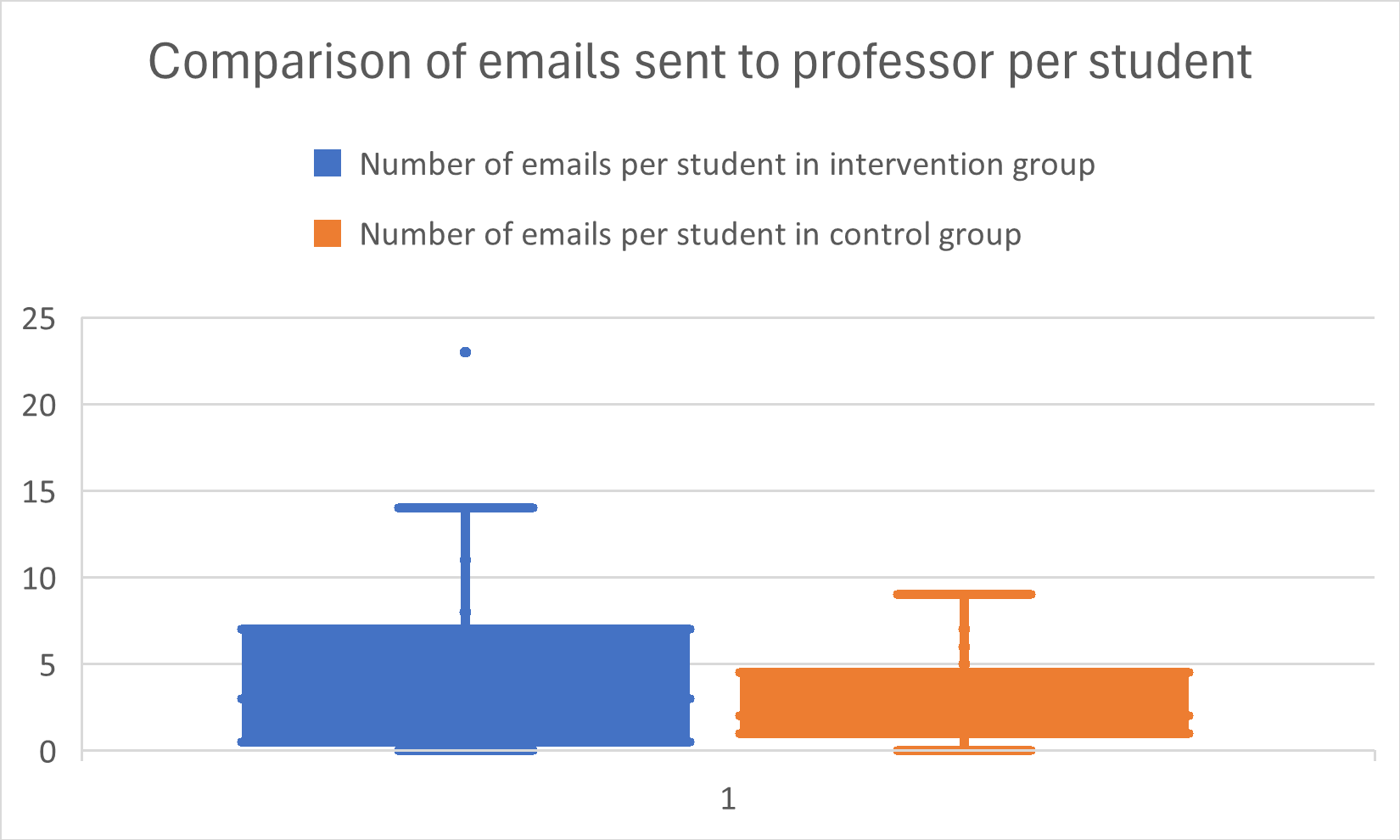
Student engagement is represented in Figure 1 and was assessed by the number of emails sent to the professor. The intervention group sent 112 emails (average 5.80 per student) while the control group sent 62 emails (average 3.40 per student). It should be noted that there was one outlier in the intervention group who sent 23 emails to the professor. If that outlier is excluded, then the intervention group still sent an average of 4.94 emails per student.
DISCUSSION AND CONCLUSION
The findings from this study suggest that the intervention had a meaningful and positive impact on multiple indicators of student retention, performance, and engagement in HLTH 101. Although retention was high in both course sections, the intervention group achieved 100% retention compared to 92% in the control group. While both rates are strong, the absence of student withdrawals in the intervention section may reflect greater student connection to the course and/or instructor during the term. Increased student–faculty interaction is associated with academic persistence (Love & Marshall, 2022), and even small improvements in engagement can influence withdrawal decisions; thus, the 100% retention rate observed here aligns with this broader research context.
The first research question asked whether talking head video feedback increases success rates. Course success rates, defined as the proportion of students earning a grade of A, B, or C, favored the intervention group. Students in the intervention section achieved a 72% success rate, compared to 65% in the control group. Although the difference is modest, it suggests that the intervention may have supported improved academic performance. Given that HLTH 101 fulfills a general education requirement, student success may have positive implications for institutional benchmarks in general education competency. As a course without prerequisites, HLTH 101 is often one of a student’s first college courses. Success in this course could encourage a student to further positive academic outcomes.
The second research question asked whether the video feedback intervention could improve student persistence as demonstrated by completion of significant assignments. A more notable difference emerged in the submission of the comprehensive general education assessment. Completion of this assignment requires substantial commitment, persistence, and motivation, making it a useful identifier for student investment in the course. In the intervention group, 88% of students submitted the assessment, compared to only 70% in the control group. This 18% difference indicates that students exposed to the intervention were more willing to undertake demanding academic tasks. Increased willingness to complete labor-intensive assignments can reflect greater engagement, suggesting that the intervention may have strengthened students’ investment in the learning process (Hammett, 2026).
The third research question considered whether student retention could be improved through video feedback. Student retention in the control group was 92%, which is good. However, retention in the control group was 100% indicating that the video feedback may have supported student retention.
The fourth research question considered whether student engagement could be improved through video feedback. Student engagement, as measured by number of email communications with the instructor, revealed the largest difference between the 2 groups. The intervention section generated 112 total emails, with a mean of 5.8 emails per student. Even when excluding an outlier who sent 23 emails, the mean remained substantially higher at 4.94 emails per student. In contrast, the control section generated 62 emails, the mean equaling 3.40 per student. Although not statistically significant, this gap indicates considerably higher levels of interaction initiated by students in the intervention section. Increased student-to-instructor communication is frequently associated with stronger relationships, deeper academic engagement, and improved course outcomes, all of which align with the trends observed in the intervention group (Bahula & Kay, 2021). This student-initiated communication also negates the perception that video feedback promotes a one-way dialog as it indicates that students want to respond and interact. It suggests that students perceive the instructor’s video feedback as demonstrating interest and concern and are more likely to interact with that instructor (Mahoney, Ajjawi & Macfarlane, 2019).
Taken together, these results provide convincing evidence that the intervention supported improved student retention, success, persistence, and engagement. A limitation of this study is its small sample size. Another limitation is that this study focused only on students in a community college, primarily those in their first year. Results may be different in other populations. Although the small sample size limits generalizability, these results suggest that the intervention meaningfully enhanced student retention, success, persistence, and engagement. A larger sample size could produce stronger results. Since this intervention targeted students who were in their first semester of community college coursework, results may not extend to students at 4-year institutions or those further in their academic journey. Results also may not be consistent for those in face-to-face classes. Future research should explore whether video usage in other areas of asynchronous online courses would be beneficial to student outcomes.
REFERENCES
- Bahula, T., & Kay, R. (2021). Exploring student perceptions of video-based feedback in higher education: A systematic review of the literature. Journal of Higher Education Theory and Practice, 21(4), 248–258. https://doi.org/10.33423/jhetp.v21i4.4224
- Hammett, K. (2026). More than kindness: Relational pedagogy and its impact on engagement, confidence, and motivation in higher education. Delta Kappa Gamma Bulletin, 92(3), 6–14. https://drive.google.com/file/d/1pL2ZuHYpcBUeo0bvTNNdY5qwvYOejFGS/view
- Johnson, E., & Clemenson, S. (2024). Registered nurse to baccalaureate completion program: Students' perceptions of online faculty caring behaviors. International Journal for Human Caring, 28(2), 92–97. https://doi.org/10.20467/IJHC-2022-0052
- Love, S., & Marshall, D. (2022). Video feedback and instructor social presence in an asynchronous online course. Journal of Effective Teaching in Higher Education, 5(2), 43–58. https://doi.org/10.36021/jethe.v5i2.324
- Lowenthal, P. R. (2022). Exploring student perceptions of asynchronous video in online courses. Distance Education, 43(3), 369–387. https://doi.org/10.1080/01587919.2022.2088479
- Mahoney, P., Ajjawi, R., & Macfarlane, S. (2019). A qualitative synthesis of video feedback in higher education. Teaching in Higher Education, 24(2), 157–179. https://doi.org/10.1080/13562517.2018.1471457
- McCarthy, J. (2015). Evaluating written, audio and video feedback in higher education summative assessment tasks. Issues in Educational Research, 25(2), 153–169. https://www.iier.org.au/iier25/mccarthy.pdf
- Zone, E., Olesch, K., & Temeltas, M. (2023). Student perceptions of written and video feedback in online introductory English composition courses: A lesson from the field. Online Journal of Distance Learning Administration, 26(3). https://ojdla.com/articles/student-perceptions-of-written-and-video-feedback-in-online-introductory-english-composition-courses-a-lesson-from-the-field