Research Article
Exploring Instructor Perceptions of Online Developmental Mathematics Courses at a Community College in Maryland
From the Mathematics Department, School of Mathematics and Science, Community College of Baltimore County, Baltimore, Maryland.
Shawntaye D. Adams, EdD
sadams2@ccbcmd.edu
ABSTRACT
This study explored the persistent problem of low success rates in online developmental mathematics courses at a Maryland community college. The purpose of the qualitative case study was to examine math instructors’ perceptions of the factors contributing to these low success rates and to better understand how instructors support adult learners in online developmental math environments. Grounded in the community of inquiry framework and andragogical principles, the study focused on instructor perspectives regarding student barriers, instructional practices, and recommendations for improving student outcomes. Using purposive sampling, 15 full-time mathematics faculty members with online teaching experience participated in the study. Data were collected through questionnaires and semi-structured interviews and analyzed using Braun and Clarke’s thematic analysis approach. Findings revealed that instructors attributed low success rates to several interconnected factors, including underprepared students, misalignment between course demands and student expectations, and insufficient engagement and real-time support in fully asynchronous courses. The findings also emphasized the importance of proactive and adaptive instructional practices, enhanced support systems, and reevaluating online course delivery models to better meet the needs of adult learners. Overall, the study highlighted the value of instructor voice in identifying practical strategies that may strengthen engagement, support, and student success in online developmental mathematics while contributing to broader conversations about effective online teaching and learning in community college settings.
INTRODUCTION
Between 2010 and 2022, and especially during the COVID-19 pandemic, higher education experienced a significant shift toward online learning (García-Morales et al., 2021; Zhou et al., 2023). Community colleges increasingly expanded online developmental mathematics offerings to provide flexible and accessible pathways for adult learners, many of whom were balancing work, family, and other responsibilities while returning to school (Awad et al., 2022; Maćkowski et al., 2022). Although online developmental math courses increased access to education, student success rates in these courses have remained persistently low (Castro-Lopez et al., 2022; Coltharp, 2020).
Existing literature identifies several challenges associated with online developmental mathematics, including low student engagement, ineffective assessment practices, math anxiety, limited technology skills, and insufficient real-time support in fully asynchronous learning environments (Ahmmed et al., 2022; Awad et al., 2022; Sole, 2020). These challenges are often intensified for adult learners and underprepared students who may require greater structure, support, and instructional responsiveness to succeed (Knowles et al., 2014). While online learning offers flexibility and convenience, it can also create barriers for students who struggle with self-regulation, digital literacy, and navigating online course systems effectively.
Much of the current scholarship on online developmental mathematics focuses primarily on student outcomes and persistence (Alshehri, 2023; Castro-Lopez et al., 2022). However, less attention has been given to the perspectives of instructors who teach these courses and work directly with students experiencing these challenges. A gap in the literature exists regarding how instructors perceive the factors contributing to low success rates and what instructional practices and support systems they believe are most effective in promoting student success in online developmental math environments.
The purpose of this qualitative case study was to explore math instructors’ perceptions regarding factors contributing to low success rates in online developmental mathematics courses at a Maryland community college. Grounded in the community of inquiry framework and andragogical principles, the study examined instructor perspectives on student barriers, instructional strategies, and recommendations for improving student engagement and success in online developmental mathematics courses. Using purposive sampling, 15 full-time mathematics faculty members with online teaching experience participated in questionnaires and semi-structured interviews.
The goal of this study was to elevate instructor voice and contribute practical insights that may help strengthen online developmental mathematics instruction and support systems for adult learners. By exploring instructor experiences and perceptions, the study sought to contribute to broader conversations regarding effective online teaching practices, student engagement, and learner-centered approaches in community college mathematics education.
METHODS
This qualitative exploratory case study examined math instructors’ perceptions of low success rates in online developmental mathematics courses at a Maryland community college. The study was grounded in the community of inquiry framework and andragogical principles, which emphasize the importance of engagement, instructional presence, collaboration, and recognizing adult learner needs in online learning environments (Garrison et al., 2000; Knowles, 1984). While much of the existing literature focuses on student outcomes and persistence in online developmental mathematics courses, fewer studies have explored the perspectives of instructors who teach these courses and work directly with underprepared adult learners.
A qualitative methodology was selected because it allowed for an in-depth exploration of instructor experiences, perceptions, and instructional practices related to online developmental mathematics education (Creswell & Poth, 2016). An exploratory case study design was used to investigate this issue within a real-world educational setting at a single Maryland community college. The bounded case for the study consisted of full-time mathematics instructors with experience teaching online developmental mathematics courses. This design provided the flexibility needed to explore complex instructional challenges and identify themes related to student success, engagement, and support.
Using purposive sampling, 15 full-time mathematics faculty members with online teaching experience participated in the study. Participants were selected because of their direct experience teaching developmental mathematics in online learning environments. Data were collected through 2 researcher-developed instruments: an open-ended questionnaire administered through Microsoft Forms and semi-structured interviews conducted virtually through Microsoft Teams. The questionnaire allowed instructors to describe their perceptions and experiences in their own words, while the interviews provided opportunities to expand upon responses and discuss instructional strategies, challenges, and recommendations in greater depth. Both instruments were aligned to the study’s research questions and were reviewed by subject matter experts to strengthen validity and alignment.
After institutional review board approval was obtained, participants were recruited through email invitations distributed to full-time mathematics faculty at the college. Participation was voluntary, and informed consent was collected electronically prior to data collection. Questionnaire responses were collected over a 2-week period, and follow-up interviews were conducted with participants who agreed to be interviewed. Interviews were video recorded and automatically transcribed through Microsoft Teams, with transcripts reviewed and corrected for accuracy. Participant identities were protected through de-identification and confidential data storage procedures.
Data were analyzed using Braun and Clarke’s (2006) thematic analysis approach. Questionnaire responses and interview transcripts were organized, coded, and analyzed using NVivo qualitative analysis software. The coding process involved reviewing transcripts multiple times, creating memos, identifying recurring patterns, and organizing codes into broader categories and themes. The analysis process involved becoming familiar with the data, generating initial codes, identifying patterns, organizing codes into broader themes, reviewing and refining themes, and developing final interpretations. Through this process, 6 major themes emerged regarding factors contributing to low success rates and strategies for improving student outcomes in online developmental mathematics courses. Strategies such as member checking, reflexive journaling, triangulation of data sources, and subject matter expert review were used to strengthen the credibility, trustworthiness, and dependability of the findings.
A full account of the study’s instruments, scope, delimitations, limitations, data collection procedures, and analysis methods is available upon request to the author or by accessing the complete dissertation (Adams, 2025).
RESULTS
Fifteen full-time mathematics instructors with experience teaching online developmental mathematics courses participated in the study. Participants completed open-ended questionnaires and follow-up semi-structured interviews designed to explore their perceptions regarding low success rates in online developmental mathematics courses. Of the participants, 53% (8 of 15) identified as male and 47% (7 of 15) identified as female. In addition, 67% of participants had at least 5 years of experience teaching online developmental mathematics courses, while 33% had fewer than 5 years of experience. This participant demographic information is provided to describe the study sample and demonstrate that participants met the inclusion criteria of having experience teaching online developmental mathematics. Although years of teaching experience and gender are reported for descriptive purposes, the study was not designed to examine differences in perceptions based on these demographic characteristics. Accordingly, participant responses were analyzed collectively to address the research questions.
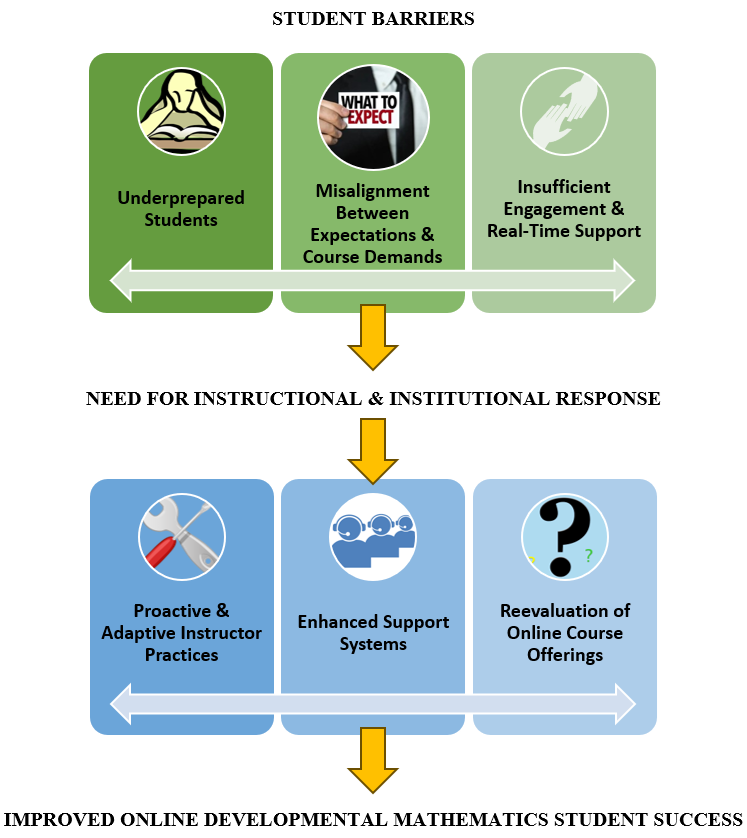
Data from questionnaires and interviews were analyzed using Braun and Clarke’s (2006) thematic analysis approach. During the open coding phase, 57 initial codes emerged from participant responses. Through axial coding and iterative review, the initial codes were condensed into 20 broader categories that ultimately resulted in 6 major themes emerging from the thematic analysis. The 6 themes, summarized in Table 1, included: (a) underprepared students, (b) misalignment between course demands and student expectations, (c) insufficient engagement and real-time support, (d) proactive and adaptive instructor practices, (e) enhanced support systems, and (f) reevaluation of online course offerings.
| Table 1. Emergent Themes Related to Low Success Rates in Online Developmental Mathematics Courses | ||
|---|---|---|
| Theme | Description | Representative Instructor Perspectives |
| Underprepared Students | Students entered courses lacking foundational math skills, technological readiness, and effective study habits. | Instructors described students struggling with basic algebra skills, navigating online platforms, and maintaining consistent study routines. |
| Misalignment Between Course Demands and Student Expectations | Students underestimated the rigor, time commitment, and independence required in online developmental math courses. | Participants noted that many students assumed online courses would be easier or less demanding than face-to-face courses. |
| Insufficient Engagement and Real-Time Support | Limited interaction and delayed feedback contributed to student frustration and disengagement in asynchronous environments. | Instructors emphasized that students often needed immediate clarification and struggled without real-time instructional support. |
| Proactive and Adaptive Instructor Practices | Instructors implemented intentional strategies to support struggling students and maintain engagement. | Participants discussed early interventions, flexible office hours, progress monitoring, reminders, and supplemental instructional resources. |
| Enhanced Support Systems | Additional institutional and course-level supports were viewed as necessary to improve student success. | Suggested supports included mandatory orientations, embedded tutoring, synchronous support sessions, and increased student outreach. |
| Reevaluation of Online Course Offerings | Participants questioned whether fully asynchronous developmental math courses adequately support underprepared learners. | Instructors recommended reconsidering course structures, reducing asynchronous offerings, and increasing live interaction opportunities. |
Underprepared Students
All 15 participants identified student underpreparedness as a major factor contributing to low success rates in online developmental mathematics courses. Instructors frequently described students as lacking foundational math skills, technological readiness, and effective study habits. One instructor stated “Many students come into the course without the foundational math skills they need. They struggle with even basic concepts, which makes it nearly impossible for them to keep up with the content online.” Another participant explained that some students “don’t even know their times tables or how to solve basic equations,” which places them at an immediate disadvantage in online courses.
In addition to academic challenges, 13 participants emphasized that many students lacked the technological skills needed to navigate online learning environments effectively. Instructors reported that students struggled with learning management systems, online homework platforms, and digital tools required for course participation. Participants also identified weak study habits and poor note-taking skills as barriers that negatively impacted student performance. Collectively, instructors viewed academic and technological underpreparedness as interconnected challenges that significantly hinder student success in online developmental math courses.
Misalignment Between Course Demands and Student Expectations
Twelve participants identified a disconnect between student expectations and the realities of online developmental mathematics courses. Instructors explained that many students enroll in online courses believing they will be easier or more convenient than face-to-face classes without understanding the level of discipline, time management, and independent learning required for success. One participant stated “Students think online courses are easier because they can do them at home, but they don’t realize how much time and effort it takes to stay on top of the material.”
Participants emphasized that students often struggle to balance coursework with work and family responsibilities and are unprepared for the self-directed nature of asynchronous learning. However, 3 participants expressed differing perspectives, suggesting that students, not course structures, should adapt to the expectations of online learning environments. These instructors emphasized the importance of student accountability, time management, and personal responsibility in achieving success.
Insufficient Engagement and Real-Time Support
Twelve participants described insufficient engagement and lack of real-time support as major contributors to low success rates in online developmental mathematics courses. Instructors explained that students frequently become frustrated when they cannot receive immediate clarification or assistance while solving problems independently. One instructor noted “Students often get stuck on a single problem and have no one to ask for immediate clarification, which can discourage them from continuing.” Another participant emphasized that the absence of live interaction leaves students feeling “disconnected” and “unsupported”.
While most instructors favored increased synchronous interaction, 3 participants expressed differing opinions and suggested that asynchronous learning environments can still be effective if students are properly prepared and actively use available resources such as discussion boards, recorded lectures, and online tutoring. These responses reflected varying perspectives regarding the role of synchronous engagement in online developmental math courses.
Proactive and Adaptive Instructor Practices
Fourteen participants emphasized the importance of proactive and adaptive instructional practices in supporting student success. Instructors described strategies such as monitoring student progress early, maintaining frequent communication, offering flexible office hours, providing supplemental instructional materials, and adapting teaching approaches to meet diverse learner needs. One participant explained “Monitoring student progress early on helps me identify those who are struggling so I can intervene before they fall too far behind.” Another instructor highlighted the value of flexible office hours for adult learners balancing work and family responsibilities.
Participants also discussed the importance of creating community and maintaining instructor presence in online environments through regular communication and group check-ins. However, one instructor expressed concern that excessive accommodation could unintentionally reduce student independence and accountability. This participant emphasized the importance of helping students develop self-discipline and independent learning skills necessary for online learning success.
Enhanced Support Systems
Thirteen participants recommended strengthening institutional and course-level support systems to improve student outcomes in online developmental mathematics courses. Suggested strategies included mandatory online orientations, embedded tutors or advisors, additional synchronous support opportunities, and initiatives designed to increase student motivation and engagement. One instructor stated “Having a tutor embedded in the course would allow students to get immediate help when they’re stuck.” Another participant emphasized the importance of mandatory orientations to help students better understand online course expectations and technology requirements before classes begin.
Although most instructors approved of expanding support systems, 2 participants expressed differing perspectives, arguing that many existing resources are already underutilized and that the primary issue lies in whether students choose to engage with the supports available to them. These participants emphasized student motivation and accountability rather than expanding institutional resources.
Reevaluation of Online Course Offerings
Twelve participants recommended reevaluating the structure and delivery of online developmental mathematics courses. Suggestions included reducing the number of asynchronous online sections, reinstating remote synchronous options, lowering enrollment caps, and increasing opportunities for live interaction and community building. One participant stated, “Offering more online sections is unethical when we know students aren’t succeeding.” Another instructor strongly advocated for replacing asynchronous developmental math courses with remote synchronous formats that provide more structure and real-time engagement.
However, 3 instructors disagreed with the need for major structural changes and argued that the current courses already provide sufficient resources and support opportunities. These participants maintained that improving student engagement with existing resources would be more effective than redesigning course delivery formats. Overall, the findings reflected varying perspectives regarding the balance between course design, institutional support, and student accountability in promoting success in online developmental mathematics courses.
DISCUSSION AND CONCLUSION
The findings of this study support and extend existing research on online developmental mathematics by highlighting several barriers that affect student success, including student underpreparedness, misaligned expectations, limited engagement, and insufficient real-time support. Figure 1 conceptualizes the instructor’s perceptions of the main barriers to student success and supports institutions can offer to improve outcomes. Instructors consistently described students as entering online developmental math courses with gaps in foundational mathematics skills, weak study habits, and limited technological readiness. These findings align with prior research indicating that underprepared students often struggle with the academic rigor, self-regulation, and digital skills needed to succeed in online learning environments (Awad et al., 2022; Coltharp, 2020; Kim et al., 2023).
The results also suggest that flexibility alone is not enough to support adult learners in online developmental mathematics. Although students may choose online courses because they appear convenient, participants indicated that many students underestimate the time, effort, and independence required to succeed. This finding aligns with previous research noting that students often misunderstand the demands of online learning (Gernsbacher, 2015; Huston & Minton, 2016). Instructors in this study emphasized the need for clearer communication, stronger onboarding, and early expectation-setting to help students better understand the realities of online developmental math before they fall behind.
Another important finding was the need for stronger engagement and real-time support. Participants repeatedly noted that students often become frustrated or disengaged when they cannot receive immediate help. This finding supports previous research emphasizing the importance of synchronous interaction, instructor presence, and social connection in online learning environments (Martin et al., 2021). Through the lens of the community of inquiry framework, these findings reinforce the importance of teaching, social, and cognitive presence in helping students feel connected, supported, and able to engage meaningfully with course content.
The findings also showed that instructors view themselves as essential to student success. Participants described proactive and adaptive practices such as monitoring student progress, sending reminders, offering flexible office hours, providing timely feedback, and creating supplemental materials. These strategies align with andragogical principles by recognizing that adult learners often balance school with work, family, and other responsibilities. However, the findings also suggest the need for balance, as some instructors cautioned that too much accommodation may limit student accountability and independence.
Participants recommended enhanced support systems, including mandatory orientations, embedded tutors or advisors, synchronous support opportunities, and motivational structures to help students persist. They also recommended reevaluating online developmental math offerings, particularly fully asynchronous formats, to determine whether these courses adequately meet the needs of developmental students. These recommendations align with existing literature emphasizing the importance of structured support, intentional course design, and ongoing improvement in online education (Alshehri, 2023; Awad et al., 2022; Brathwaite et al., 2020; Maciejewski et al., 2021).
If this study were expanded, student perspectives would be included to compare instructor perceptions with students’ actual experiences. Future research should also examine the long-term impact of specific interventions, such as mandatory orientations, embedded tutoring, synchronous sessions, and proactive instructor outreach. Additional research on professional development for online developmental math instructors would also be valuable, particularly in helping faculty implement learner-centered, interactive, and adaptive teaching strategies.
Overall, this study highlights the importance of instructor voice in understanding and improving online developmental mathematics. The findings suggest that online developmental math students benefit from clear expectations, early intervention, real-time support, and intentional course design. Faculty, administrators, and institutional leaders can use these findings to strengthen online teaching practices, improve support systems, and make more informed decisions about how online developmental math courses should be structured to promote student engagement, persistence, and success.
ACKNOWLEDGMENTS
I thank the leadership team within the School of Mathematics and Science and my colleagues within the Mathematics Department at the Community College of Baltimore County who assisted in and supported this study throughout the research process. Their encouragement, insight, and willingness to participate contributed greatly to the successful completion of this research.
REFERENCES
- Adams, S. (2025). Exploring math instructors' perceptions of online developmental mathematics courses at a community college in Maryland: A qualitative exploratory case study [Doctoral dissertation]. https://hdl.handle.net/20.500.12520/399
- Ahmmed, S., Saha, J., & Tamal, M. A. (2022). Effectiveness of need-based teacher’s training program to enhance online teaching quality. Education Research International, 2022, 1–13. https://doi.org/10.1155/2022/4118267
- Alshehri, S. M. (2023). Students’ perceptions in undergraduate online math courses. Cogent Education, 10(1), 1–22. https://doi.org/10.1080/2331186X.2023.2203069
- Awad, N., Santos, I., & Assadi, N. (2022). Instructors’ perceptions of teaching online during emergency remote teaching: The case of a teacher education college. Journal of Educators Online, 19(3), 1–15. https://doi.org/10.9743/jeo.2022.19.3.4
- Brathwaite, J., Fay, M. P., & Moussa, A. (2020). Improving developmental and college-level mathematics: Prominent reforms and the need to address equity (CCRC Working Paper No. 124). Community College Research Center. http://files.eric.ed.gov/fulltext/ED609226.pdf
- Braun, V., & Clarke, V. (2006). Using thematic analysis in psychology. Qualitative Research in Psychology, 3(2), 77–101. https://doi.org/10.1191/1478088706qp063oa
- Castro-Lopez, A., Cervero, A., Galve-González, C., Puente, J., & Bernardo, A. B. (2022). Evaluating critical success factors in the permanence in higher education using multi-criteria decision-making. Higher Education Research & Development, 41(3), 628–646. https://doi.org/10.1080/07294360.2021.1877631
- Coltharp, J. (2020). Instruction type, student major, and success in developmental mathematics. Journal of Developmental Education, 44(1), 18–24. http://files.eric.ed.gov/fulltext/EJ1320656.pdf
- Creswell, J. W., & Poth, C. N. (2016). Qualitative inquiry and research design: Choosing among five approaches. Sage.
- García-Morales, V. J., Garrido-Moreno, A., & Martín-Rojas, R. (2021). The transformation of higher education after the COVID disruption: Emerging challenges in an online learning scenario. Frontiers in Psychology, 12, Article 616059. https://doi.org/10.3389/fpsyg.2021.616059
- Garrison, D. R., Anderson, T., & Archer, W. (2000). Critical inquiry in a text-based environment: Computer conferencing in higher education. The Internet and Higher Education, 2(2–3), 87–105. https://doi.org/10.1016/S1096-7516(00)00016-6
- Gernsbacher, M. A. (2015). Why internet-based education? Frontiers in Psychology, 5, Article 1530. https://doi.org/10.3389/fpsyg.2014.01530
- Huston, J., & Minton, T. (2016). Comparison of course completion rates in intermediate algebra based on term and modality. International Forum of Teaching & Studies, 12(2), 18–25. https://americanscholarspress.us/journals/IFST/pdf/IFOTS-2-2016/v12n2-art2.pdf
- Kim, H. J., Kong, Y., & Tirotta-Esposito, R. (2023). Promoting diversity, equity, and inclusion: An examination of diversity-infused faculty professional development programs. Journal of Higher Education Theory & Practice, 23(11), 138–153. https://doi.org/10.33423/jhetp.v23i11.6224
- Knowles, M. S. (1984). Andragogy in action: Applying modern principles of adult learning. Jossey-Bass.
- Knowles, M. S., Holton, E. F., III, & Swanson, R. A. (2014). The adult learner: The definitive classic in adult education and human resource development. Routledge.
- Maciejewski, W., Tortora, C., & Bragelman, J. (2021). Beyond skill: Students’ dispositions towards math. Journal of Developmental Education, 44(2), 18–25. http://files.eric.ed.gov/fulltext/EJ1320648.pdf
- Maćkowski, M., Żabka, M., Kempa, W., Rojewska, K., & Spinczyk, D. (2022). Computer aided math learning as a tool to assess and increase motivation in learning math by visually impaired students. Disability & Rehabilitation: Assistive Technology, 17(5), 559–569. https://doi.org/10.1080/17483107.2020.1800116
- Martin, F., Kumar, S., & She, L. (2021). Examining higher education instructor perceptions of roles and competencies in online teaching. Online Learning, 25(4), 267–295. https://doi.org/10.24059/olj.v25i4.2570
- Sole, M. A. (2020). Streamlining time spent in alternative developmental mathematics pathways: Increasing access to college-level mathematics courses by altering placement procedures. Journal of Mathematics Education at Teachers College, 11(1), 43–54. https://doi.org/10.7916/jmetc.v11i1.6708
- Zhou, X., Smith, C. J. M., & Al-Samarraie, H. (2023). Digital technology adaptation and initiatives: A systematic review of teaching and learning during COVID-19. Journal of Computing in Higher Education, 36(3), 813–834. https://doi.org/10.1007/s12528-023-09376-z