Research Article
The Effect of Virtual Simulation on Associate Degree Nursing Students’ Perceived Anxiety and Self-Efficacy Levels
From the Nursing Department, School of Health Professions, Community College of Baltimore County, Baltimore, Maryland.
Jennifer D. Marlatt, DNP, MSN, RN
jmarlatt@ccbcmd.edu
ABSTRACT
The benefits of simulation-based learning in nursing education are well documented throughout the literature. However, nursing students can experience heightened anxiety and low self-efficacy levels during high-fidelity mannequin-based simulations which can adversely affect performance and learning outcomes. Although there has been much research exploring high-fidelity simulation and the effect on anxiety in nursing students, a paucity of research exists evaluating the effects of virtual simulation, an emerging pedagogic tool in nursing education, on students’ anxiety and self-efficacy. Underpinned by Bandura’s Social Cognitive Theory, this study sought to measure the effect of a virtual simulation experience on student anxiety and self-efficacy levels. A quantitative, quasi-experimental 1-group pretest-posttest research design was used. The sample consisted of 26 2nd-semester medical-surgical nursing students enrolled in a community college in the Mid-Atlantic Region of the United States. Data were collected using a self-report 27-item survey questionnaire administered pre- and post-intervention. Pre- and post-test scores revealed a statistically significant increase in self-confidence (p < 0.001) and a statistically significant decrease in anxiety (t(25) = 4.0, 95% CI [8.4, 26.1], p < 0.001). This study supports the use of virtual simulation as an alternative or complementary evidence-based pedagogical tool for experiential learning in nursing education. Analysis of participants’ perceptions indicated that virtual simulation had a positive impact on anxiety and self-efficacy outcomes.
INTRODUCTION
Simulation is a teaching-learning modality that allows nursing students to practice clinical nursing skills in a safe environment without risk to patient safety (Kapucu, 2017; Kim et al., 2016). Simulation-based learning is used in the nursing curricula by nurse educators as an efficacious educational strategy that allows the student to transition from theory to practice (Kang et al., 2020; Meum et al., 2020). Although simulation is not a new pedagogy in nursing education, virtual simulation (VS) has emerged to the forefront in the last several years as an essential component of nursing education (Padilha et al., 2018).
VS is an innovative technological teaching strategy that provides a safe learning environment that prepares students to practice in today’s complex healthcare milieu (Coyne et al., 2021). The use of VS technology in nursing education is rapidly increasing, as a review of literature revealed many recent studies which found VS to be an effective pedagogical strategy in nursing education (Foronda et al., 2018; Foronda et al., 2020; Gu et al., 2017; Padilha et al., 2018; Padilha et al., 2019; Shorey & Ng, 2021; Verkuyl & Hughes, 2019; Wright et al., 2018). Research further supported using VS as an efficacious learning modality to develop and improve clinical judgment and enhance students’ knowledge (Fogg et al., 2020; Gu et al., 2017; Haerling, 2018; Padilha et al., 2019). This evidence-based teaching approach places the student in an autonomous role, allowing the opportunity to practice and apply knowledge in a controlled learning environment. In this safe student-centered learning environment, free of patient harm, students are able to learn from the decision-making and actions taken during the VS experience (Foronda et al., 2018; Verkuyl & Hughes, 2019). Through repetition of the patient scenario and immediate feedback on actions taken during the VS experience, the learner can practice nursing skills until mastered.
Anxiety is a universal phenomenon among undergraduate nursing students, which has been well documented in the literature (Cheung et al., 2016; Kachaturoff et al., 2020; Rathnayake & Ekanayaka, 2016; Villeneuve et al., 2018; Wedgeworth, 2016). Heightened feelings of anxiousness and stress experienced by nursing students may inhibit learning, leading to increased attrition rates within the nursing program (Turner & McCarthy, 2017). Research indicates that the use of simulation can cause profound anxiety to undergraduate nursing students already experiencing high-stress levels from the demands of nursing school (Al-Ghareeb et al., 2017; Cantrell et al., 2017; George et al., 2020; Reed & Ferdig, 2021; Shearer, 2016; Yockey & Henry, 2019). An integrative review examining the stress that nursing students experienced during high-fidelity simulations found anxiety to be a universal theme throughout the literature (Cantrell et al., 2017). Evidence from studies included in this review indicated that nursing students’ simulation stress was higher than clinical stress (Cantrell et al., 2017).
Anxiety is closely connected to memory, learning, and performance (Al-Ghareeb et al., 2017). The presence of anxiety has the potential to interfere with cognitive learning and impede the effectiveness of simulation as a teaching-learning strategy in nursing education (Al-Ghareeb et al., 2017; Gosselin et al., 2016). The literature suggests that a heightened level of anxiety during simulation can result in poor performance, errors, and insufficient learning (Reed & Ferdig, 2021; Yockey & Henry, 2019). These indicators can carry over to the clinical practice setting, potentially impacting the provision of quality nursing care and patient outcomes. Shearer (2016) conducted a review of the literature which focused specifically on the effects of anxiety on nursing students’ simulation experience. Three themes emerged from the synthesis of literature: fear of the unknown, being critiqued by peers and faculty, and the experience of making mistakes. While a small level of anxiety is normal and may facilitate learning, anxiety that interferes with a student’s cognition can impair learning and alter judgment (Al-Ghareeb et al., 2017; Yockey & Henry, 2019). Cognitive interference caused by heightened anxiety can inhibit critical thinking processes further impeding students from making appropriate clinical decisions, which can cause quality of care and patient safety issues such as medication errors (Mills et al., 2016).
Self-efficacy is an important outcome of simulation-based education (Arslan et al., 2018) and a key indicator of students’ performance in nursing education, as well as in determining clinical competence (Karabacak et al., 2019). Bandura described self-efficacy as being “concerned with judgments of how well one can execute courses of action required to deal with prospective situations” (1982, p. 122). In other words, self-efficacy is an individual’s confidence in the ability to succeed in a particular situation. Bandura (1986) believed that students with decreased self-efficacy tend to avoid challenging tasks and situations that previously led to failure. Conversely, if students believe that they will succeed at a specific task, they will use maximum capabilities to succeed. Individuals with strong self-efficacy view challenging problems as tasks to be mastered (Bandura, 1986). Self-efficacy is closely associated with simulation-based education in that self-efficacy can affect confidence, success, and performance (Moorfoot & Stanley, 2018). Students who possess high levels of self-efficacy are more prone to be confident and competent in the clinical environment, therefore leading to quality patient care (Mohamadirizi et al., 2015).
Several studies found that VS can enhance nursing students’ self-efficacy (Jallad & Işık, 2021; Mabry et al., 2020; Verkuyl et al., 2017a; Verkuyl et al., 2017b). Satisfaction, high levels of engagement, enhanced knowledge, and self-efficacy were positive outcomes found related to the use of VS (Verkuyl et al., 2017a). Another study evaluated if the intervention of a VS prior to a high-fidelity medical-surgical simulation would reduce students’ anxiety while increasing confidence, performance, and self-efficacy (Mabry et al., 2020). The researchers found that using VS as preparation for a high-fidelity simulation students’ perception of self-efficacy was significantly increased. A systematic review by Jallad and Işık (2021) focused on the effectiveness of VS as a teaching-learning strategy in nursing education and the effects on students’ self-efficacy, self-confidence, and anxiety levels. The study found that VS can be a reliable and effective educational strategy to decrease anxiety and increase nursing students’ self-confidence and self-efficacy. However, the authors recommended future research on the use of VS in nursing education with current technology to examine the effectiveness in improving affective outcomes such as self-efficacy and anxiety.
In contrast, Padilha et al. (2019) found no statistical differences in self-efficacy perceptions between students who received VS and students who did not. Although the study assessed learner satisfaction, self-efficacy, knowledge retention, and clinical reasoning, the assessment of students’ perception of self-efficacy was only administered immediately post intervention. The students’ self-efficacy perception levels prior to the intervention were not measured. Despite the increased use of VS in nursing education, there is still a paucity of studies evaluating the effects of VS on students’ anxiety and self-efficacy levels. The review of the literature found inconclusive evidence on the effectiveness of VS on affective outcomes. Current research has focused on how VS affects the cognitive domain, but further research is needed to evaluate VS’s impact on the affective domains.
To address this gap in the literature, underpinned by Bandura’s Social Cognitive Theory, this study examined the effect of a clinical VS experience on second semester associate degree nursing (ADN) students’ perceived anxiety and self-efficacy in the first medical-surgical nursing course. The study was guided by the following research question: Among 2nd-semester ADN students enrolled in a medical-surgical nursing course, does participation in a clinical VS experience reduce perceived anxiety and improve perceived self-efficacy from pre-intervention to post-intervention?
METHODS
A quantitative, quasi-experimental 1-group pretest-posttest research design was used to measure the effects of a VS experience on 2nd-semester ADN students’ perceived anxiety and self-efficacy levels. Institutional review board approval was obtained prior to participant recruitment. All students meeting the inclusion criteria were invited to participate during a recruitment session. Participation was voluntary, and students self-selected into the study after providing informed consent. Participants were recruited using a non-probability convenience sampling method. Participant recruitment was based on self-selection rather than investigator selection, thereby minimizing opportunities for investigator selection bias.
Inclusion criteria consisted of 2nd-semester ADN students enrolled in their first medical-surgical nursing course who were not repeating the course, had previously participated in a face-to-face mannequin-based simulation, and had not previously participated in a VS experience. The study was conducted within a traditional ADN program at a large metropolitan public community college located in the Mid-Atlantic Region of the United States. Demographic data included age, gender, English as primary language, ethnicity, years of healthcare experience, highest degree completed, and comfort level with computer technology.
Self-efficacy was conceptually defined as “People’s judgments about their capabilities to organize and execute courses of action required to attain designated types of performance” (Bandura, 1986, p. 391). The Nursing Anxiety and Self-Confidence with Clinical Decision-Making scale (NASC-CDM©; White, 2014) was used to measure participants’ perception of levels of self-efficacy and anxiety pre- and post-intervention. The NASC-CDM© is a self-report, 6-point Likert scale instrument which consists of 27 items in 2 subscales: self-confidence and anxiety (White, 2014). The scale has demonstrated validity and internal consistency reliability for each subscale. The Cronbach’s alpha for the self-confidence subscale is α = 0.97 and the anxiety subscale is α = 0.96 (White, 2014).
The intervention for this project was a web-based medical-surgical VS patient case scenario. The VS web-based platform chosen for this study was vSim® for Nursing. The VS experience was scheduled in conjunction with theory content and was completed prior to the first medical-surgical exam, with the primary goal of reinforcing concepts taught in theory. Prior to the VS, consenting participants accessed the Qualtrics® survey page to complete the demographic questionnaire and the NASC-CDM© scale. Following the VS experience, study participants completed the NASC-CDM© scale using Qualtrics®.
Data collected from the NASC-CDM© scale and demographic survey was exported from Qualtrics® survey software for analysis. Statistical data analysis was conducted using IBM SPSS Statistics version 27.0. Descriptive statistics of student demographic data (age, gender, race, English as primary language, highest level of education, healthcare experience, and technology skill level) were analyzed using frequencies and percentages. Means and standard deviations were calculated for pretest and posttest self-confidence and anxiety levels. Nominal and categorical data were first analyzed with frequencies and percentages and then for inferential testing, both Wilcoxon signed rank tests and paired samples t-tests were used. Paired samples t-tests were performed to evaluate whether statistically significant differences existed between both the mean anxiety subscale scores and self-confidence subscale scores before and after participation in the VS. The threshold for statistical significance was a p-value of < 0.05. Additionally, the Wilcoxon signed rank test was performed on the self-confidence subscale because the data violated the paired samples t-test assumption of normality.
RESULTS
Of the 30 students in the population who met inclusion criteria, 27 nursing students consented to participate in this study. However, 1 participant did not complete the posttest and was excluded from the study, resulting in a sample size of 26 participants. Mean age was 28.31 years (SD = 7.83). The majority were female (n = 23; 88.5%), African American (n = 9; 34.6%), and reported English as their first language (n = 23; 88.5%). Most participants indicated the highest degree obtained as high school (n = 17; 65.4%) and were on the associates to bachelor’s degree program track (n = 17; 65.4%). It was nearly split between those who work in healthcare (n = 12; 46.2%) and those who did not (n = 14; 53.8%), with the majority of those working indicating positions of a medical assistant or certified nursing assistant. Table 1 provides the full demographic characteristics of the sample.
| Table 1. Demographic Characteristics of the Sample (N = 26). | ||
|---|---|---|
| Age | ||
| Mean age ± SD | 28.31y ± 7.83y | |
| Age range | 21–51y | |
| Gender | ||
| Female | 23 (88.5%) | |
| Male | 3 (11.5%) | |
| Race / ethnicity | ||
| African American | 9 (34.6%) | |
| Caucasian | 8 (30.8%) | |
| Hispanic | 7 (26.9%) | |
| Another race/ethnicity | 2 (7.7%) | |
| First language is English | ||
| Yes | 23 (88.5%) | |
| No | 3 (11.5%) | |
| Highest degree completed | ||
| High school | 17 (65.4%) | |
| Trade school | 1 (3.8%) | |
| Bachelor’s degree | 7 (26.9%) | |
| Master’s degree or higher | 1 (3.8%) | |
| Program track | ||
| Traditional | 9 (34.6%) | |
| Associate to Bachelor’s | 17 (65.4%) | |
| Healthcare experience | ||
| Yes | 12 (46.2%) | |
| No | 14 (53.8%) | |
| Computer technology skills rating | ||
| Poor | 1 (3.8%) | |
| Average | 15 (57.7%) | |
| Excellent | 10 (38.5%) | |
The NASC-CDM© scale demonstrated strong internal consistency and reliability for both the self-confidence subscale (Cronbach’s α = 0.945) and anxiety subscale (Cronbach’s α = 0.970). The self-confidence subscale difference scores failed to demonstrate normality; therefore, a Wilcoxon signed-rank test was run to determine the effect of the VS on the NASC-CDM© self-confidence subscale scores. Mean pretest self-confidence score was 98.6 (SD = 16.8) and mean posttest score was 118.5 (SD = 21.3). Of the 26 participants, there was a statistically significant increase in self-confidence as measured by the NASC-CDM© from pretest (Mdn = 99.0) to posttest (Mdn = 108.5), p < 0.001.
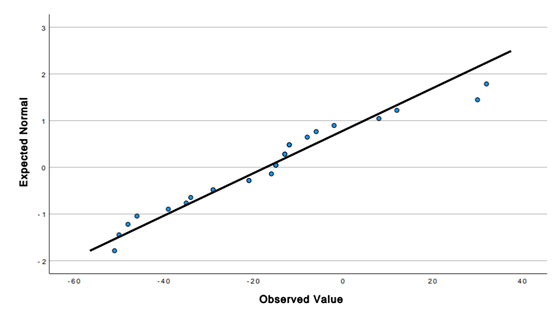
The anxiety subscale difference scores demonstrated all assumptions indicative of using the paired-samples t test to determine the effect of the VS on the NASC-CDM© anxiety subscale scores. Figure 1 depicts how the data met the assumption of normality. Anxiety scores decreased from pretest (M = 73.7; SD = 23.5) to posttest (M = 56.5; SD = 22.8), a statistically significant decrease of 17.2 points, t(25) = 4.0, 95% CI [8.4 – 26.1], p < 0.001. The results are presented in Table 2. Overall, the students demonstrated significantly higher self-confidence scores and significantly lower anxiety scores following participation in the VS experience.
DISCUSSION AND CONCLUSION
Participation in the VS experience significantly increased self-confidence and significantly decreased anxiety levels among 2nd-semester ADN students enrolled in their first medical-surgical nursing course. The findings supported the study purpose of measuring the effect of a VS experience on anxiety and self-efficacy levels of prelicensure nursing students. Underpinned by Bandura’s Social Cognitive Theory, participation in a VS experience may positively influence nursing students’ perceived self-efficacy by providing opportunities to practice clinical decision-making in a safe learning environment.
Previous studies found that VS can enhance nursing students’ self-efficacy and self-confidence (Jallad & Işık, 2021; Mabry et al., 2020; Verkuyl et al., 2017a; Verkuyl et al., 2017b). The study findings are consistent with the current VS literature related to the effect VS has on the affective learning outcomes of anxiety and self-efficacy. The autonomous and repetitive nature of the VS experience may have contributed to the increase in students’ self-confidence levels by allowing participants to practice clinical decision-making skills in a safe learning environment.
Consistent with existing literature, anxiety levels decreased following participation in the VS experience (Jallad & Işık, 2021). Unlike traditional high-fidelity mannequin-based simulation experiences, VS may provide students with a safe learning environment while still promoting clinical reasoning and decision-making skills. The opportunity to repeat the patient scenario and receive immediate feedback may have contributed to lower anxiety levels among participants following the VS experience.
Additional studies using larger sample sizes, multiple nursing programs, and comparison groups are recommended to further evaluate the effects of VS on students’ anxiety and self-efficacy levels. Future research examining the long-term effects of VS on clinical performance and clinical judgment is also warranted.
The results of the study contributed to the body of knowledge related to the use of VS in nursing education as an innovative pedagogical methodology to improve self-efficacy and lower anxiety levels of prelicensure nursing students. The findings may assist nurse educators in integrating VS as a teaching-learning strategy to support affective learning outcomes and clinical decision-making in prelicensure nursing education. Furthermore, the study provided evidence-based practice findings that supported VS as an alternative simulation-based learning technique in nursing education to improve self-efficacy and decrease anxiety, thus better preparing students for entry-level practice as confident and competent registered nurses.
REFERENCES
- Adhikari, R., Kydonaki, C., Lawrie, J., O'Reilly, M., Ballantyne, B., Whitehorn, J., & Paterson, R. (2021). A mixed-methods feasibility study to assess the acceptability and applicability of immersive virtual reality sepsis game as an adjunct to nursing education. Nurse Education Today, 103, Article 104944. https://doi.org/10.1016/j.nedt.2021.104944
- Al-Ghareeb, A. Z., Cooper, S. J., & McKenna, L. G. (2017). Anxiety and clinical performance in simulated setting in undergraduate health professionals education: An integrative review. Clinical Simulation in Nursing, 13(10), 478–491. https://doi.org/10.1016/j.ecns.2017.05.015
- Bandura, A. (1982). Self-efficacy mechanism in human agency. American Psychologist, 37(2), 122–147. https://doi.org/10.1037/0003-066x.37.2.122
- Bandura, A. (1986). Social foundations of thought and action: A social cognitive theory. Prentice Hall.
- Cantrell, M. L., Meyer, S. L., & Mosack, V. (2017). Effects of simulation on nursing student stress: An integrative review. Journal of Nursing Education, 56(3), 139–144. https://doi.org/10.3928/01484834-20170222-04
- Cheung, T., Wong, S., Wong, K., Law, L., Ng, K., Tong, M., Wong, K., Ng, M., & Yip, P. (2016). Depression, anxiety and symptoms of stress among baccalaureate nursing students in Hong Kong: A cross-sectional study. International Journal of Environmental Research and Public Health, 13(8), Article 779. https://doi.org/10.3390/ijerph13080779
- Coyne, E., Calleja, P., Forster, E., & Lin, F. (2021). A review of virtual-simulation for assessing healthcare students’ clinical competency. Nurse Education Today, 96, Article 104623. https://doi.org/10.1016/j.nedt.2020.104623
- Espinosa, B., Morán-Peña, L., García-Piña, M. A., González-Ramírez, P., & López-Ruíz, C. M. (2019). Self-confidence and anxiety as intervening factors in clinical decision-making in newly nursing bachelor graduates. American Journal of Nursing Science, 8(2), 59–67. https://doi.org/10.11648/j.ajns.20190802.14
- Fogg, N., Kubin, L., Wilson, C., & Trinka, M. (2020). Using virtual simulation to develop clinical judgment in undergraduate nursing students. Clinical Simulation in Nursing, 48, 55–58. https://doi.org/10.1016/j.ecns.2020.08.010
- Foronda, C. L., Fernandez-Burgos, M., Nadeau, C., Kelley, C. N., & Henry, M. N. (2020). Virtual simulation in nursing education: A systematic review spanning 1996 to 2018. Simulation in Healthcare: The Journal of the Society for Simulation in Healthcare, 15(1), 46–54. https://doi.org/10.1097/SIH.0000000000000411
- Foronda, C. L., Swoboda, S. M., Henry, M. N., Kamau, E., Sullivan, N., & Hudson, K. (2018). Student preferences and perceptions of learning from vSim for Nursing™. Nurse Education in Practice, 33, 27–32. https://doi.org/10.1016/j.nepr.2018.08.003
- George, T. P., DeCristofaro, C., & Murphy, P. (2020). Self-efficacy and concerns of nursing students regarding clinical experiences. Nurse Education Today, 90, Article 104401. https://doi.org/10.1016/j.nedt.2020.104401
- Gosselin, K. P., Holland, B., Mulcahy, A., Williamson, S., & Widacki, A. (2016). Music for anxiety reduction and performance enhancement in nursing simulation. Clinical Simulation in Nursing, 12(1), 16–23. https://doi.org/10.1016/j.ecns.2015.12.002
- Gu, Y., Zou, Z., & Chen, X. (2017). The effects of vSim for Nursing™ as a teaching strategy on fundamentals of nursing education in undergraduates. Clinical Simulation in Nursing, 13(4), 194–197. https://doi.org/10.1016/j.ecns.2017.01.005
- Jallad, S., & Işık, B. (2021). The effectiveness of virtual reality simulation as learning strategy in the acquisition of medical skills in nursing education: A systematic review. Irish Journal of Medical Science, 191, 2267–2277. https://doi.org/10.1007/s11845-021-02695-z
- Kang, S., Hong, C., & Lee, H. (2020). The impact of virtual simulation on critical thinking and self-directed learning ability of nursing students. Clinical Simulation in Nursing, 49, 66–72. https://doi.org/10.1016/j.ecns.2020.05.008
- Kapucu, S. (2017). The effects of using simulation in nursing education: A thorax trauma case scenario. International Journal of Caring Sciences, 10(2), 1069–1074. https://www.internationaljournalofcaringsciences.org/docs/47_kapucu_ABSTRACT_10_2.pdf
- Mabry, J., Lee, E., Roberts, T., & Garrett, R. (2020). Virtual simulation to increase self-efficacy through deliberate practice. Nurse Educator, 45(4), 202–205. https://doi.org/10.1097/NNE.0000000000000758
- Padilha, J., Machado, P., Ribeiro, A., & Ramos, J. (2018). Clinical virtual simulation in nursing education. Clinical Simulation in Nursing, 15, 13–18. https://doi.org/10.1016/j.ecns.2017.09.005
- Padilha, J., Machado, P., Ribeiro, A., Ramos, J., & Costa, P. (2019). Clinical virtual simulation in nursing education: Randomized controlled trial. Journal of Medical Internet Research, 21(3), Article e11529. https://doi.org/10.2196/11529
- Rathnayake, S., & Ekanayaka, J. (2016). Depression, anxiety and stress among undergraduate nursing students in a public university in Sri Lanka. International Journal of Caring Sciences, 9(3), 1020–1032. https://www.researchgate.net/publication/312017216_Depression_Anxiety_and_Stress_among_Undergraduate_Nursing_Students_in_a_Public_University_in_Sri_Lanka
- Reed, J. M., & Ferdig, R. E. (2021). Gaming and anxiety in the nursing simulation lab: A pilot study of an escape room. Journal of Professional Nursing, 37(2), 298–305. https://doi.org/10.1016/j.profnurs.2021.01.006
- Shearer, J. N. (2016). Anxiety, nursing students, and simulation: State of the science. Journal of Nursing Education, 55(10), 551–554. https://doi.org/10.3928/01484834-20160914-02
- Shorey, S., & Ng, E. (2021). The use of virtual reality simulation among nursing students and registered nurses: A systematic review. Nurse Education Today, 98, Article 104662. https://doi.org/10.1016/j.nedt.2020.104662
- Turner, K., & McCarthy, V. (2017). Stress and anxiety among nursing students: A review of intervention strategies in literature between 2009 and 2015. Nurse Education in Practice, 22, 21–29. https://doi.org/10.1016/j.nepr.2016.11.002
- Verkuyl, M., & Hughes, M. (2019). Virtual gaming simulation in nursing education: A mixed-methods study. Clinical Simulation in Nursing, 29, 9–14. https://doi.org/10.1016/j.ecns.2019.02.001
- Verkuyl, M., Hughes, M., Tsui, J., Betts, L., St-Amant, O., & Lapum, J. (2017a). Virtual gaming simulation in nursing education: A focus group study. Journal of Nursing Education, 56(5), 274–280. https://doi.org/10.3928/01484834-20170421-04
- Verkuyl, M., Romaniuk, D., Atack, L., & Mastrilli, P. (2017b). Virtual gaming simulation for nursing education: An experiment. Clinical Simulation in Nursing, 13(5), 238–244. https://doi.org/10.1016/j.ecns.2017.02.004
- Villeneuve, P., Heale, R., Rietze, L., & Carter, L. (2018). Exploring self-perceptions of anxiety among nursing students in the clinical setting and select demographics. International Journal of Nursing Education Scholarship, 15(1), 1–11. https://doi.org/10.1515/ijnes-2017-0042
- White, K. A. (2014). Development and validation of a tool to measure self-confidence and anxiety in nursing students during clinical decision making. Journal of Nursing Education, 53(1), 14–22. https://doi.org/10.3928/01484834-20131118-05
- Wright, R. R., Tinnon, E. A., & Newton, R. H. (2018). Evaluation of vSim for nursing in an adult health nursing course: A multisite pilot study. CIN: Computers, Informatics, Nursing, 36(2), 84–89. https://doi.org/10.1097/CIN.0000000000000388
- Yockey, J., & Henry, M. (2019). Simulation anxiety across the curriculum. Clinical Simulation in Nursing, 29, 29–37. https://doi.org/10.1016/j.ecns.2018.12.004